Scalars and Vectors
Matthew Williams
||6 min readCSEC PhysicsPaper 01Paper 02ResultantScalarsSection AVectors
Scalar and vector quantities, finding resultants using scale diagrams and the triangle method, and resolving vectors into components.
Every physical quantity is either a scalar or a vector.
Scalars have magnitude only. Distance, speed, mass, energy, temperature, and time are all scalars. Adding or subtracting scalars uses ordinary arithmetic.
Vectors have both magnitude and direction. Displacement, velocity, acceleration, force, and momentum are vectors. You cannot simply add two vector quantities numerically unless they point in exactly the same direction.
| Scalar | Vector equivalent |
|---|---|
| Distance | Displacement |
| Speed | Velocity |
| Mass | Weight (force) |
| Energy | Force |
| Acceleration | |
| Momentum |
Representing Vectors
A vector is drawn as an arrow. The length of the arrow represents the magnitude (to scale), and the arrowhead shows the direction.
When a problem involves forces acting at angles, you must treat them as vectors and find the resultant, the single force that has the same effect as all the original forces combined.
Finding the Resultant
Parallel and Anti-parallel Vectors
If two forces act in the same direction, the resultant is their sum. If they act in opposite directions, the resultant is their difference, pointing in the direction of the larger force.
- 30 N east + 20 N east = 50 N east
- 30 N east + 20 N west = 10 N east
Triangle Method (head-to-tail)
For two forces at an angle, draw them tip to tail and close the triangle:
- Draw the first vector to scale.
- From its tip, draw the second vector to scale.
- Draw the resultant from the tail of the first to the tip of the second.
- Measure the length of the resultant and convert using the scale.
- Measure the direction of the resultant using a protractor, taken at its tail (the starting point of the first vector).
Parallelogram Method
An alternative scale diagram method for two vectors drawn from the same point:
- Draw both vectors to scale from a common origin O.
- Complete the parallelogram by drawing a line parallel to each vector from the tip of the other.
- The resultant is the diagonal of the parallelogram, drawn from O to the opposite corner.
- Measure the diagonal's length and convert using the scale; measure its angle with a protractor.
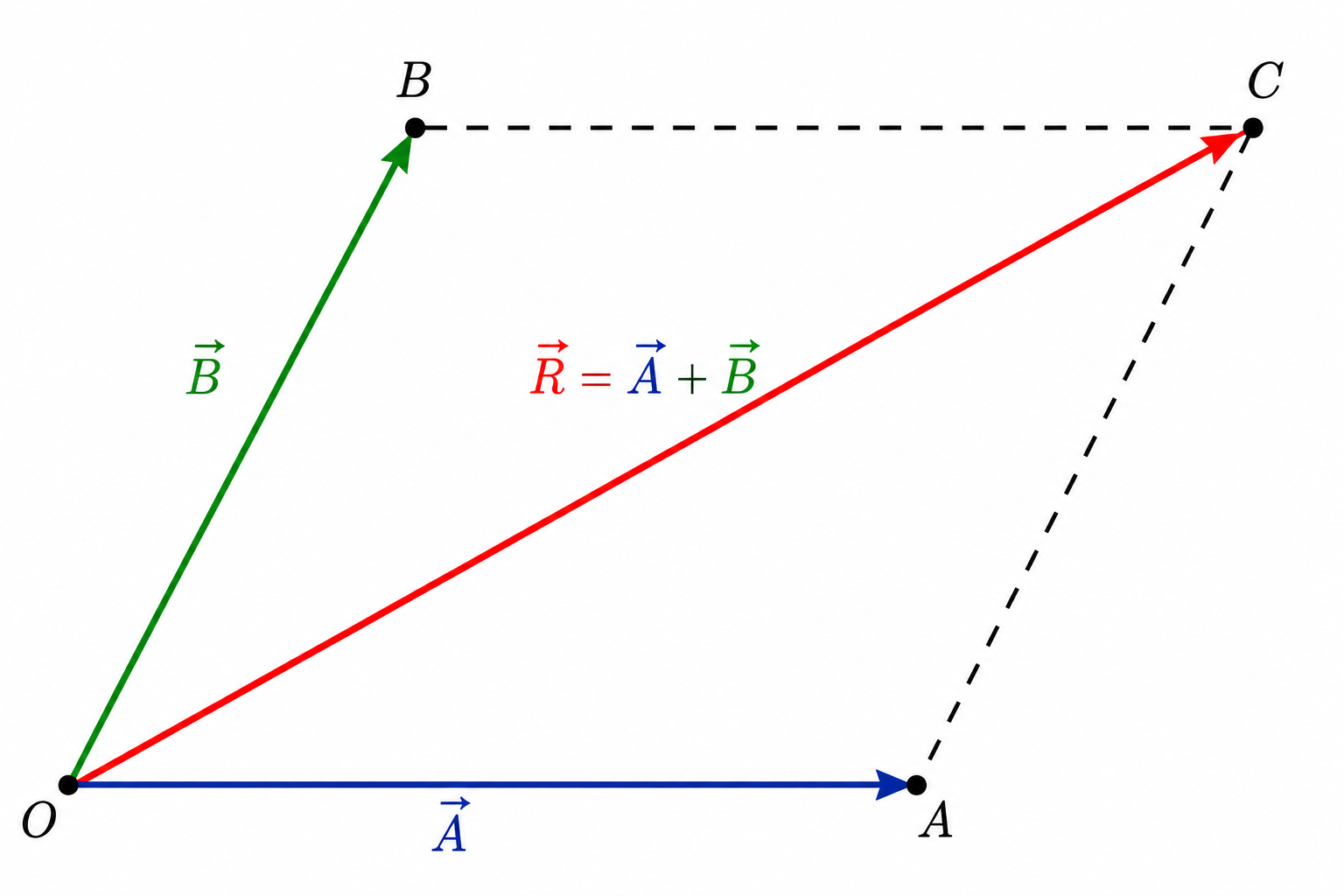
Both methods give the same resultant. The triangle method is more common in exam questions; the parallelogram method is useful when both vectors naturally start from the same point (for example, two forces acting on a single object).
Stating the Final Answer
A vector answer must always give both magnitude and direction. State the angle relative to a clearly named reference from the question: horizontal, vertical, or a compass direction. Never write just "20 N at 30°" without saying what the 30° is measured from.
Exam Tip
Always state the scale clearly in scale diagram problems. For example: "1 cm represents 10 N." The examiner expects to see the scale, the construction lines, and the measured resultant with both its magnitude and direction stated.
Perpendicular Vectors (Pythagoras)
When two forces are at 90° to each other, you can find the resultant magnitude using Pythagoras:
The angle of the resultant to is:
ExamplePerpendicular forces
A boat's engine exerts a force of 800 N due north. A current exerts a force of 600 N due east. Find the magnitude and direction of the resultant force.
The resultant force is 1000 N at 36.9° east of north.
Resolving Vectors into Components
Just as two perpendicular components can be combined into a single resultant, the reverse is also true: any single vector is equivalent to two perpendicular component vectors. The single vector and its two components produce exactly the same effect; they are interchangeable.
This is the reverse of finding a resultant. For a force at angle to the horizontal:
Resolving is most useful when several forces act on an object at different angles. Resolve each into horizontal and vertical components, add all the horizontals together and all the verticals together, then find the resultant of those two totals.
Exam Tip
In CSEC exam questions, perpendicular force problems are far more common than general angle problems. Know Pythagoras and basic trigonometry well. For scale diagram questions, a sharp pencil, a ruler, and a protractor are essential, the mark scheme checks your construction.
Equilibrium of Forces
When the resultant of all forces acting on an object is zero, the object is in equilibrium, it is stationary or moving at constant velocity (Newton's First Law). For three forces to be in equilibrium, they must form a closed triangle when drawn head-to-tail.