Refraction and Total Internal Reflection
Matthew Williams
||7 min readCSEC PhysicsOptical FibresPaper 01Paper 02RefractionRefractive IndexSection CSnell's LawTotal Internal Reflection
Snell's Law, the refractive index (n = sin i / sin r and n = c/v), real and apparent depth, critical angle, conditions for total internal reflection, optical fibres, prisms, and the periscope.
Refraction
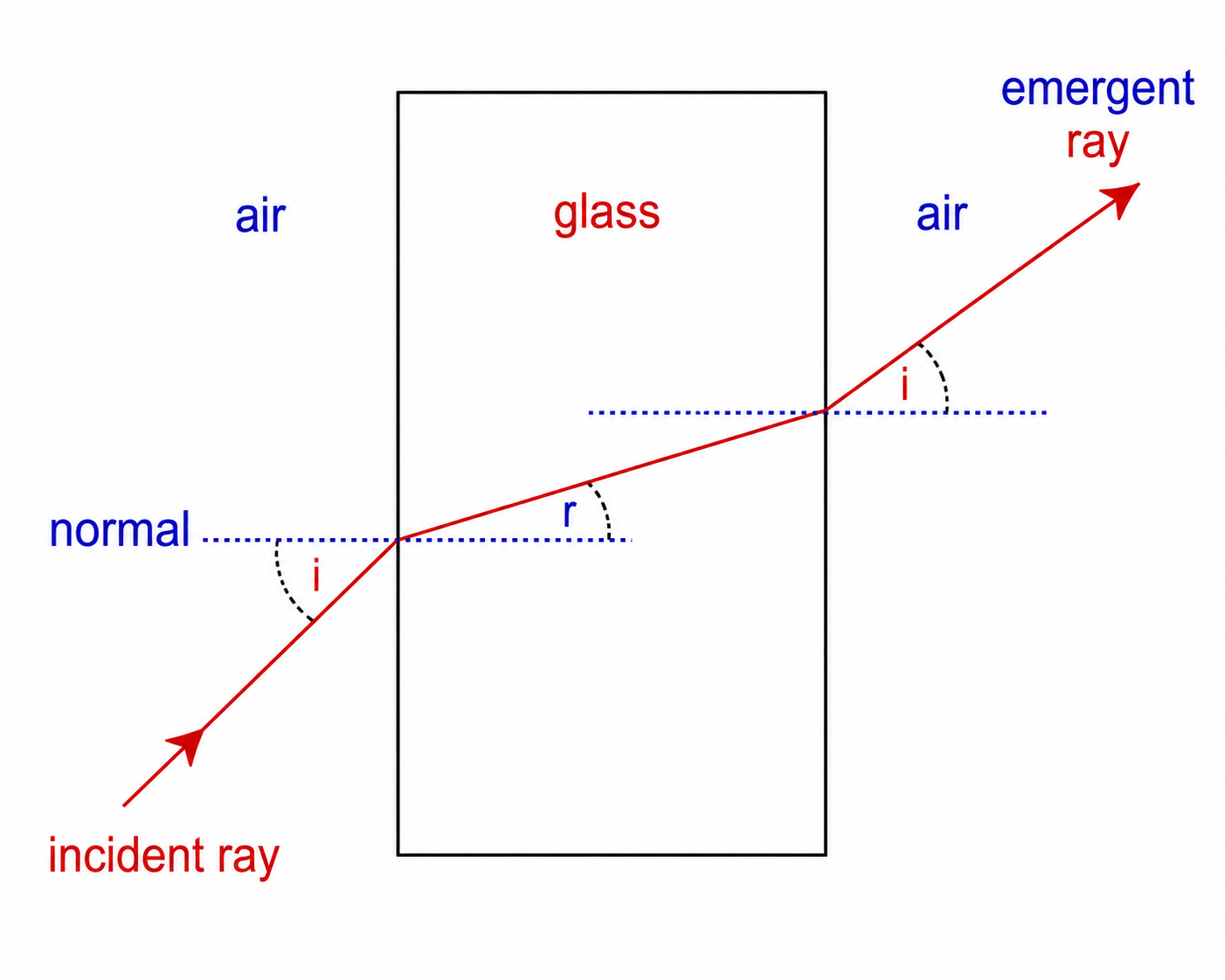
Refraction is the change in direction of a wave when it passes from one medium into another in which its speed is different. Light bends toward the normal when it slows down (entering a denser medium) and away from the normal when it speeds up (entering a less dense medium).
Normal incidence (90° to the boundary) produces no bending.
Snell's Law and Refractive Index
The refractive index () of a medium is the ratio of the speed of light in a vacuum (or air) to the speed of light in that medium:
where is the speed of light in air ( m s⁻¹) and is the speed of light in the medium. A higher refractive index means a slower speed of light in that medium.
The refractive index is also expressed through Snell's Law:
where is the angle of incidence and is the angle of refraction (both measured from the normal to the boundary). Both definitions give the same value of .
Real and Apparent Depth
When an object at the bottom of a pool of water is viewed from above, it appears closer to the surface than it really is, refraction at the water-air interface bends the light outward. The apparent depth is less than the real depth:
A coin at the bottom of a 1.3 m pool (n = 1.3) appears to be at depth m.
Just in Case
Real depth is the actual measured distance from the surface to the object. Apparent depth is the depth at which the object appears to be when viewed from outside the medium. The object always appears shallower than it really is when viewed from a less dense medium (e.g. looking into water from air).
Critical Angle and Total Internal Reflection
When light travels from a denser medium to a less dense medium (e.g. from glass to air), the refracted ray bends away from the normal. As the angle of incidence increases, so does the angle of refraction.
At the critical angle , the refracted ray travels along the boundary (angle of refraction = 90°). Beyond the critical angle, no refraction occurs, all light is reflected back into the denser medium. This is total internal reflection (TIR).
Two conditions for TIR:
- Light must be travelling from a denser medium to a less dense medium.
- The angle of incidence must be greater than the critical angle.
Applications of Total Internal Reflection
Optical Fibres
Optical fibres are thin strands of glass or plastic. Light entering one end hits the curved walls at angles greater than the critical angle and is totally internally reflected along the fibre, even around bends. The light exits at the other end with very little loss.
Applications: telecommunications (internet cables), endoscopy (medical imaging of the inside of the body).
Prism and Dispersion
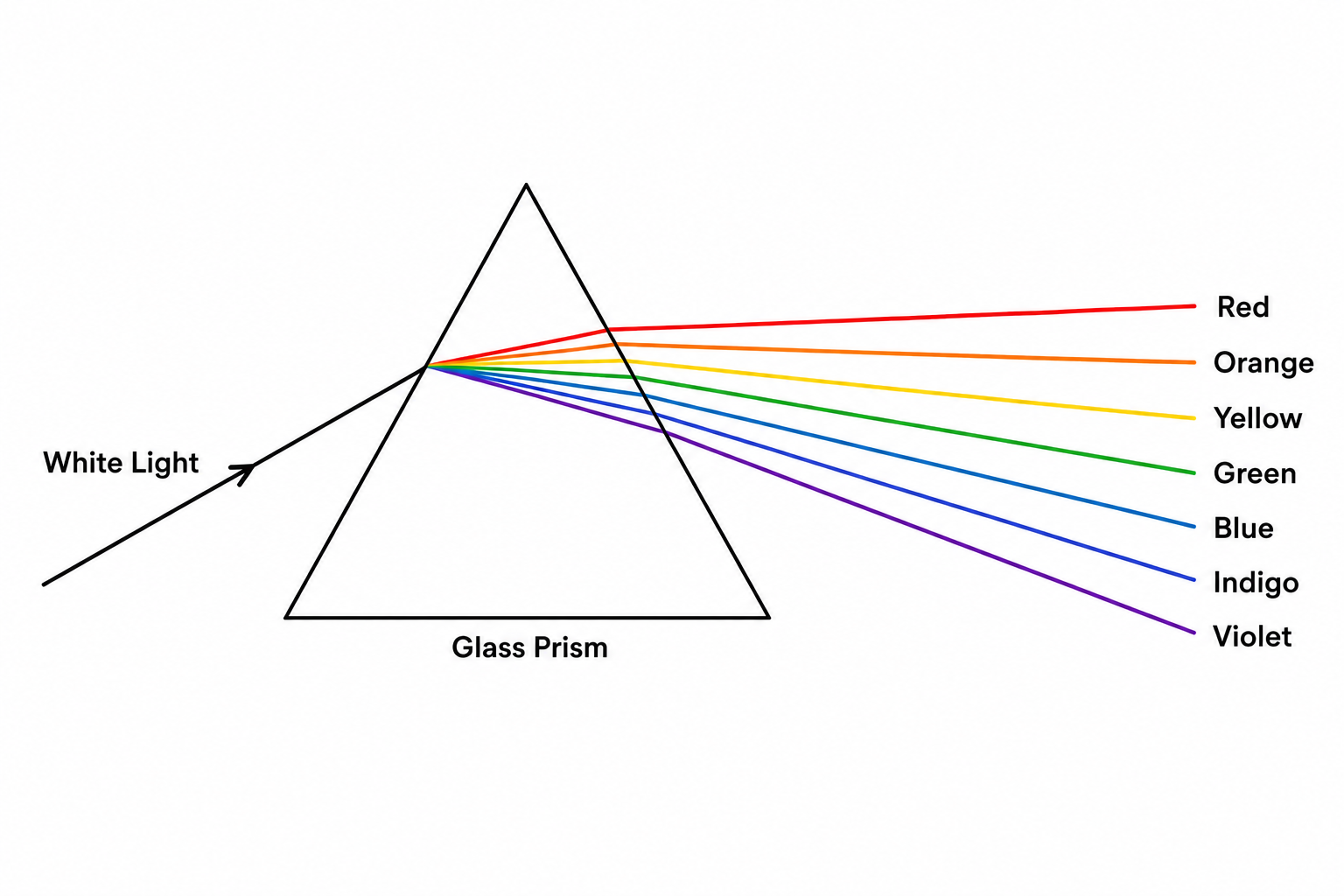
White light is a mixture of all the colours of the visible spectrum. When it enters a triangular glass prism at an angle, each colour is refracted by a slightly different amount. This happens because the speed of each colour in glass is slightly different, so their refractive indices differ slightly.
- Red light travels fastest in glass → lowest refractive index → refracted least.
- Violet light travels slowest in glass → highest refractive index → refracted most.
The prism's two non-parallel refracting surfaces compound this separation: the colours emerge spread out into a continuous band called a spectrum — red, orange, yellow, green, blue, indigo, violet (ROYGBIV). This spreading of white light into its component colours is called dispersion. Isaac Newton was the first to demonstrate this effect using a glass prism.
Right-Angle Prism
A glass prism (refractive index approximately 1.5, critical angle approximately 42°) can totally internally reflect light at its 45° face, since 45° > 42°. Two prisms can form a periscope or binoculars without the need for mirrors, with no light loss.
ExampleRefraction and critical angle calculations (2023 Paper 02, Q3)
The refractive index of water is 1.3. The speed of light in air is m s⁻¹.
Speed of light in water:
Critical angle of water:
Light inside water hitting the surface at angles greater than 50.3° is totally internally reflected.
ExampleRefraction through ice (2021 Paper 02, Q3)
Light enters a cube of ice at face MN. The refractive index of ice is 1.31. The angle of incidence on face MN is 30°.
Angle of refraction:
Light bends toward the normal on entering the denser ice.
Exam Tip
The critical angle formula only applies when going from the denser medium to air (or vacuum). For the derivation: at the critical angle, the angle of refraction is exactly 90°, so Snell's Law gives , hence .
Always state the two conditions for total internal reflection together: denser to less dense medium, AND angle of incidence exceeds the critical angle.