Magnetism
Matthew Williams
||5 min readCSEC PhysicsField LinesMagnetic FieldMagnetismPaper 01Paper 02Permanent MagnetsSection D
Magnetic and non-magnetic materials, permanent and temporary magnets, poles and forces between them, the definition of a magnetic field, field line patterns for bar magnets and between poles, and plotting with a compass.
Magnetic and Non-Magnetic Materials
Magnetic materials are attracted to magnets. Common magnetic materials include iron, nickel, cobalt, and alloys containing them.
Non-magnetic materials are not attracted to magnets. These include copper, aluminium, wood, glass, and most plastics.
Permanent and Temporary Magnets
| Type | Material | Properties |
|---|---|---|
| Permanent magnet | Steel, alnico, magnadur (ceramic ferrite) | Retains magnetism after the magnetising force is removed, "hard" magnetic material |
| Temporary (soft) magnet | Soft iron, mumetal, permalloy | Magnetised easily by an external field but loses magnetism when the field is removed, "soft" magnetic material |
Soft iron is used in electromagnet cores because it becomes strongly magnetised when current flows and loses its magnetism when the current is switched off, essential for relays and electric motors.
Steel is used for permanent magnets (fridge magnets, compass needles, loudspeaker magnets) because it retains magnetism.
Poles and Forces
Every magnet has a north pole (N) and a south pole (S). The north pole is defined as the end that points toward geographic north when the magnet is freely suspended.
Rule of poles:
- Like poles repel (N-N, S-S).
- Unlike poles attract (N-S).
Magnetic Fields
A magnetic field is a region in which a magnetic material or a moving charge experiences a force. The direction of the field at a point is defined as the direction in which the north pole of a small test compass would point.
Field Line Conventions
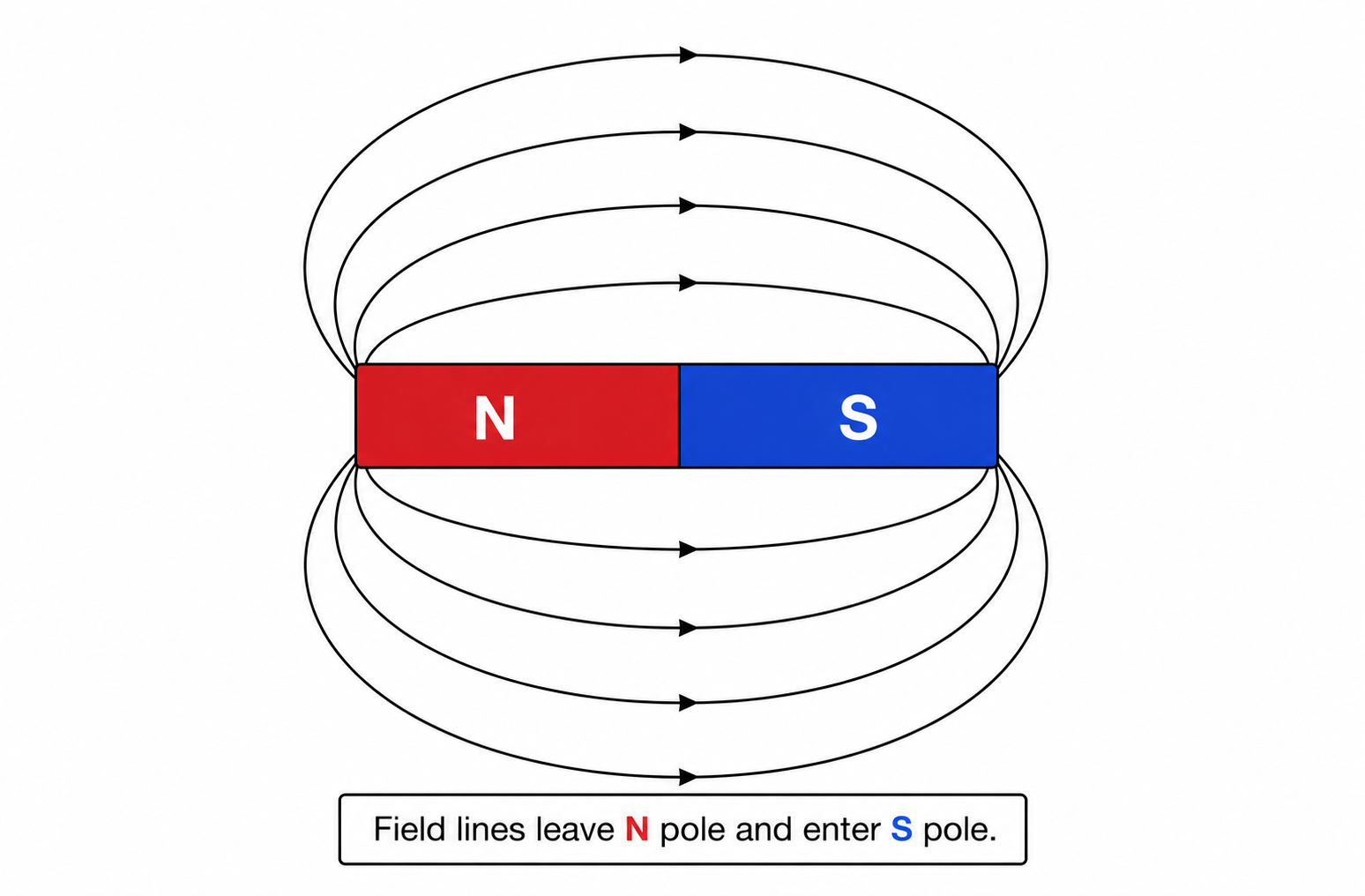
- Field lines emerge from the north pole and enter the south pole.
- Arrows on field lines show the direction a north pole would move (N to S outside the magnet).
- Closely spaced lines indicate a strong field; widely spaced lines indicate a weak field.
- Field lines never cross.
Field Patterns
Bar magnet: Field lines emerge from N, curve around, and re-enter at S. Near the poles, lines are densely packed (strong field).
Between two unlike poles (N facing S): Lines run directly from N to S between the poles, approximately uniform in the central region.
Between two like poles (N facing N): Lines push away from each other. A neutral point exists midway between the poles where the net field is zero.
Plotting Magnetic Fields
A small compass is placed at various positions around the magnet. The compass needle aligns with the local field. Mark the direction of the needle tip at each position and join the marks smoothly to draw field lines.
Induced Magnetism
When an unmagnetised magnetic material (e.g. a nail) is placed near or in contact with a magnet, it becomes magnetised by induction. The end nearest the magnet acquires the opposite polarity to the inducing pole (because unlike poles attract). Induced magnetism in soft iron disappears when the magnet is removed.
Exam Tip
A common question asks which end of an induced magnet faces the original magnet. The answer: the opposite pole, because unlike poles attract and hold the material in place.
Permanent magnets use steel or other "hard" magnetic materials. Electromagnet cores use soft iron or mumetal because they respond quickly to changes in the magnetising current.