Light, Reflection, and Mirrors
Matthew Williams
||7 min readCSEC PhysicsLightPaper 01Paper 02PeriscopePlane MirrorReflectionSection C
Rectilinear propagation, shadows and eclipses, the pinhole camera, laws of reflection, properties of images in a plane mirror, and the periscope.
Theories of Light
Scientists have held different views about the nature of light:
| Scientist | Theory | Evidence / Key idea |
|---|---|---|
| Newton (17th century) | Particle (corpuscle) theory | Light consists of tiny particles; explained reflection and refraction |
| Huygens (17th century) | Wave theory | Light is a wave; explained diffraction and interference better than particles |
| Young (1801) | Wave theory confirmed | Double-slit experiment showed light produces interference fringes, a wave behaviour |
| Einstein (1905) | Particle (photon) theory | Photoelectric effect showed light also behaves as discrete packets of energy (photons) |
The modern view is that light has a dual nature: it behaves as a wave in some experiments (interference, diffraction) and as a particle in others (photoelectric effect). For the purposes of reflection and refraction, the ray (particle-like) model is used.
Young's Double-Slit Experiment
Thomas Young (1801) passed light through two narrow slits close together. Instead of two bright bands on the screen, he observed a pattern of alternating bright and dark fringes. This can only be explained if light is a wave:
- Where crests from both slits arrive together, constructive interference produces a bright fringe.
- Where a crest from one slit meets a trough from the other, destructive interference produces a dark fringe.
This was the first convincing evidence that light is a transverse wave.
Why diffraction of light is not normally observed: Diffraction (spreading through a gap) is most pronounced when the gap size is similar to the wavelength. The wavelength of visible light is extremely small (- m), so everyday gaps and obstacles are millions of times wider — light therefore casts sharp shadows and appears to travel in straight lines. Sound diffracts easily around corners because its wavelengths (0.1 m to 10 m) match everyday obstacle sizes.
Rectilinear Propagation of Light
Light travels in straight lines through a uniform medium. This is called rectilinear propagation and is demonstrated by the fact that an opaque object placed in the path of light casts a sharp shadow.
Shadows
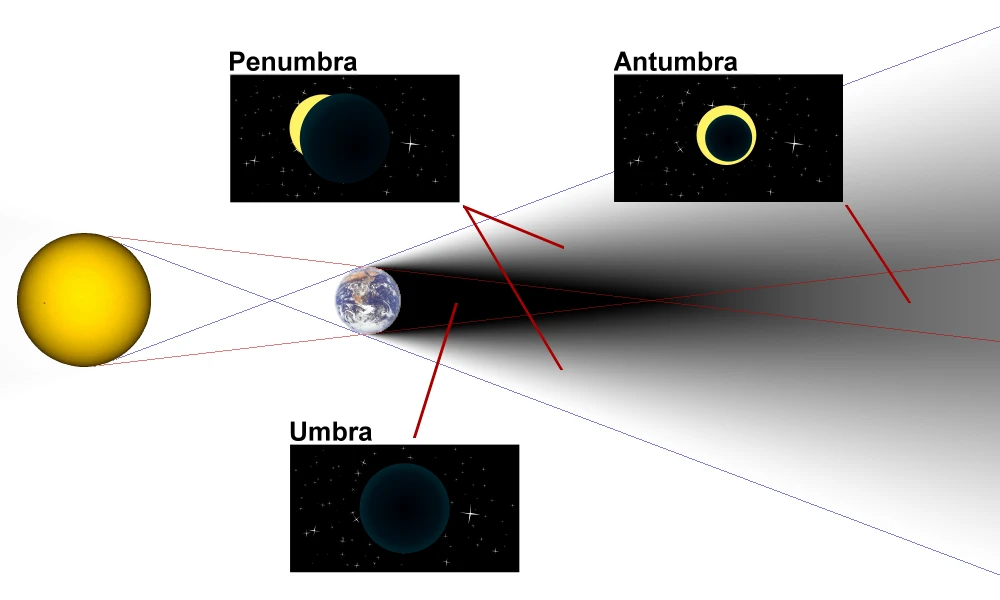
When an opaque object blocks a point source of light, a single dark shadow called an umbra forms, a region that receives no light.
When the source is extended (not a point), two shadow regions form:
- Umbra: region of complete shadow (no light from the source reaches it).
- Penumbra: region of partial shadow (some light from the source reaches it, but not all).
Eclipses
The same geometry explains solar and lunar eclipses:
Solar eclipse: The Moon moves between the Sun and the Earth. In the umbra of the Moon's shadow, a total solar eclipse is observed. In the penumbra, a partial eclipse occurs.
Lunar eclipse: The Earth moves between the Sun and the Moon. The Moon enters Earth's shadow and appears dark.
The Pinhole Camera
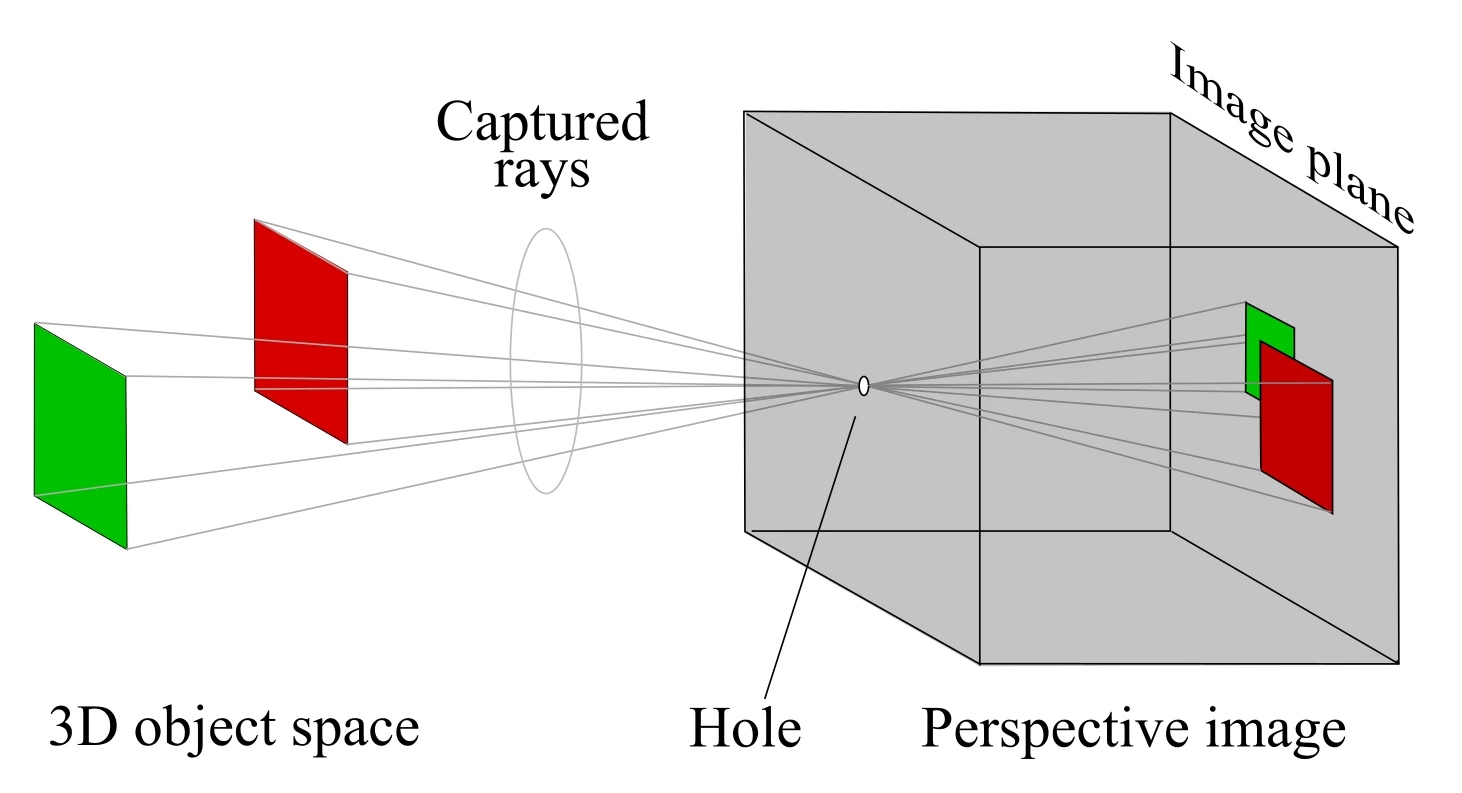
A pinhole camera is a box with a tiny hole in one face and a translucent screen on the opposite face. Light from each point of the object passes through the hole in a straight line and forms an inverted image on the screen.
Properties of the pinhole camera image:
- Inverted (upside down and laterally reversed).
- Smaller than the object if the camera is shorter than the object distance.
- Dimmer than a lens image (very little light passes through the pinhole).
- Increasing the pinhole size makes the image brighter but blurs it; decreasing it sharpens the image but dims it.
Laws of Reflection
When light reflects from any surface, two laws always hold:
- The angle of incidence equals the angle of reflection (both measured from the normal to the surface at the point of incidence).
- The incident ray, reflected ray, and normal all lie in the same plane.
Images in a Plane Mirror
When an object is placed in front of a plane (flat) mirror, the image formed has the following properties:
| Property | Description |
|---|---|
| Nature | Virtual — the image is formed where light rays appear to come from but do not actually meet; it cannot be projected onto a screen |
| Upright | Right-way up (erect) |
| Laterally inverted | Left and right appear swapped (e.g. text appears reversed) |
| Same size | Image size equals object size |
| Same distance | Image is as far behind the mirror as the object is in front of it |
The image is behind the mirror because the eye traces reflected rays back as if they came from behind the mirror surface.
Just in Case
A virtual image is one formed where light rays appear to diverge from but do not actually meet; it cannot be projected onto a screen. A real image is formed where light rays actually converge; it can be projected onto a screen. All images formed by plane mirrors are virtual.
ExamplePlane mirror image location
An object is placed 12 cm in front of a plane mirror. The image is formed 12 cm behind the mirror surface. The total object-to-image distance is 24 cm.
If the object moves 3 cm closer (now 9 cm from the mirror), the image also moves 3 cm closer to the mirror's back surface, and the total separation becomes 18 cm.
The Periscope
A simple periscope uses two plane mirrors (or two right-angle prisms) set at 45° to the horizontal, one above the other. Light enters the top mirror, reflects downward, then reflects again at the bottom mirror to the observer's eye. Periscopes are used in submarines and trenches to see above obstacles.
Exam Tip
Always measure angles of incidence and reflection from the normal, not from the mirror surface. A common error is measuring from the mirror itself, which gives the complement of the correct angle.
For plane mirror questions: the image is the same distance behind the mirror as the object is in front of it. State that the image is virtual, upright, laterally inverted, and the same size as the object.