Lenses
Matthew Williams
||6 min readConverging LensCSEC PhysicsDiverging LensLensesMagnificationPaper 01Paper 02Ray DiagramsSection C
Converging and diverging lenses, principal focus and focal length, the three standard rays for ray diagrams, real versus virtual images, magnification, the lens formula, and everyday applications.
Types of Lenses
A converging (convex) lens is thicker in the middle than at the edges. It brings parallel rays of light to a real focus (the principal focus ) on the other side of the lens.
A diverging (concave) lens is thinner in the middle than at the edges. It spreads parallel rays apart so that they appear to come from a virtual focus on the same side as the incoming light.
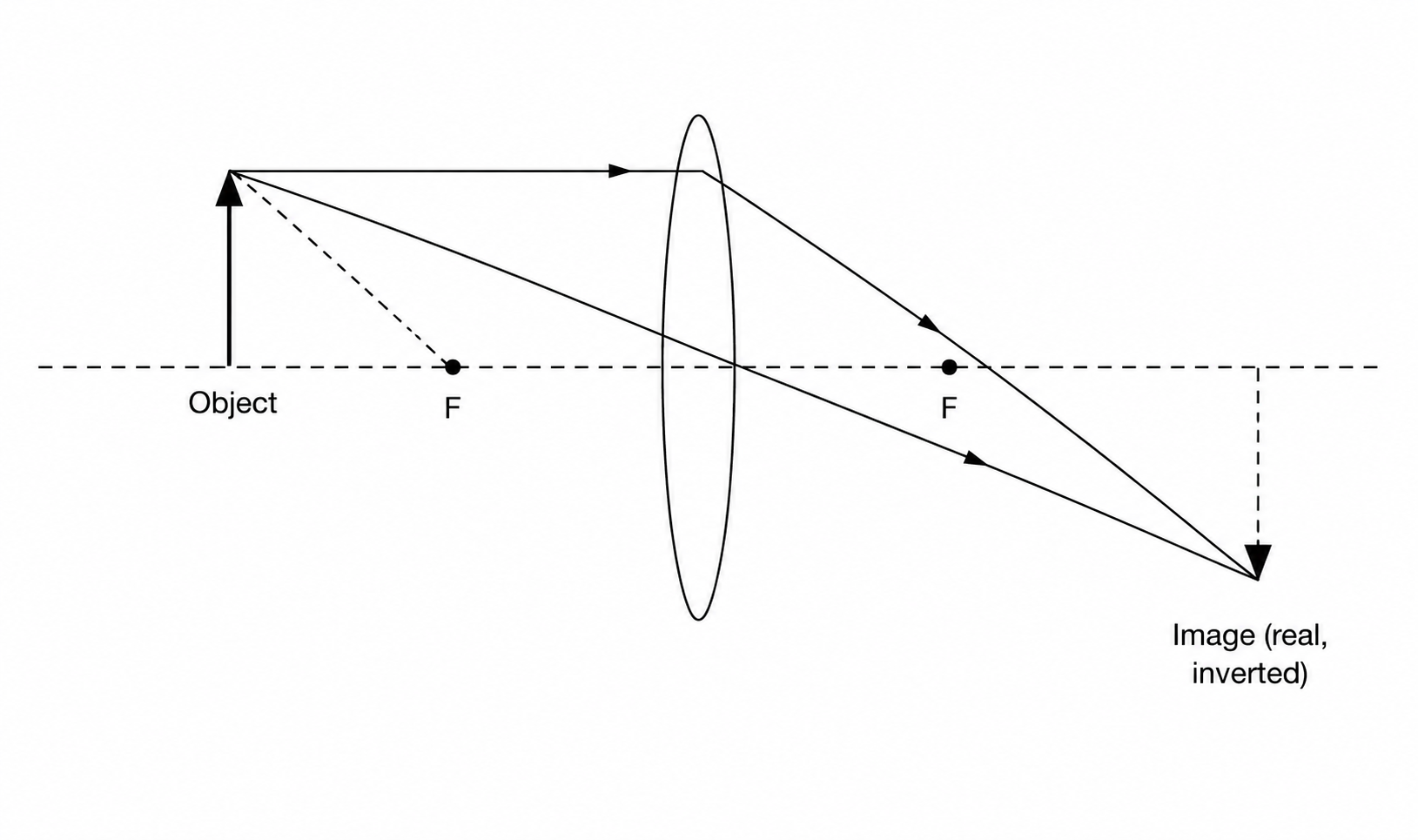
The focal length is the distance from the optical centre of the lens to the principal focus.
Ray Diagrams
Three standard rays are used to locate an image:
- A ray parallel to the principal axis, refracts through the principal focus (converging) or appears to come from (diverging).
- A ray through the optical centre, passes straight through without bending.
- A ray through the near focal point (converging) or directed toward the far (diverging), emerges parallel to the principal axis.
The image is where any two of these rays intersect (or appear to intersect, for virtual images).
Image Types
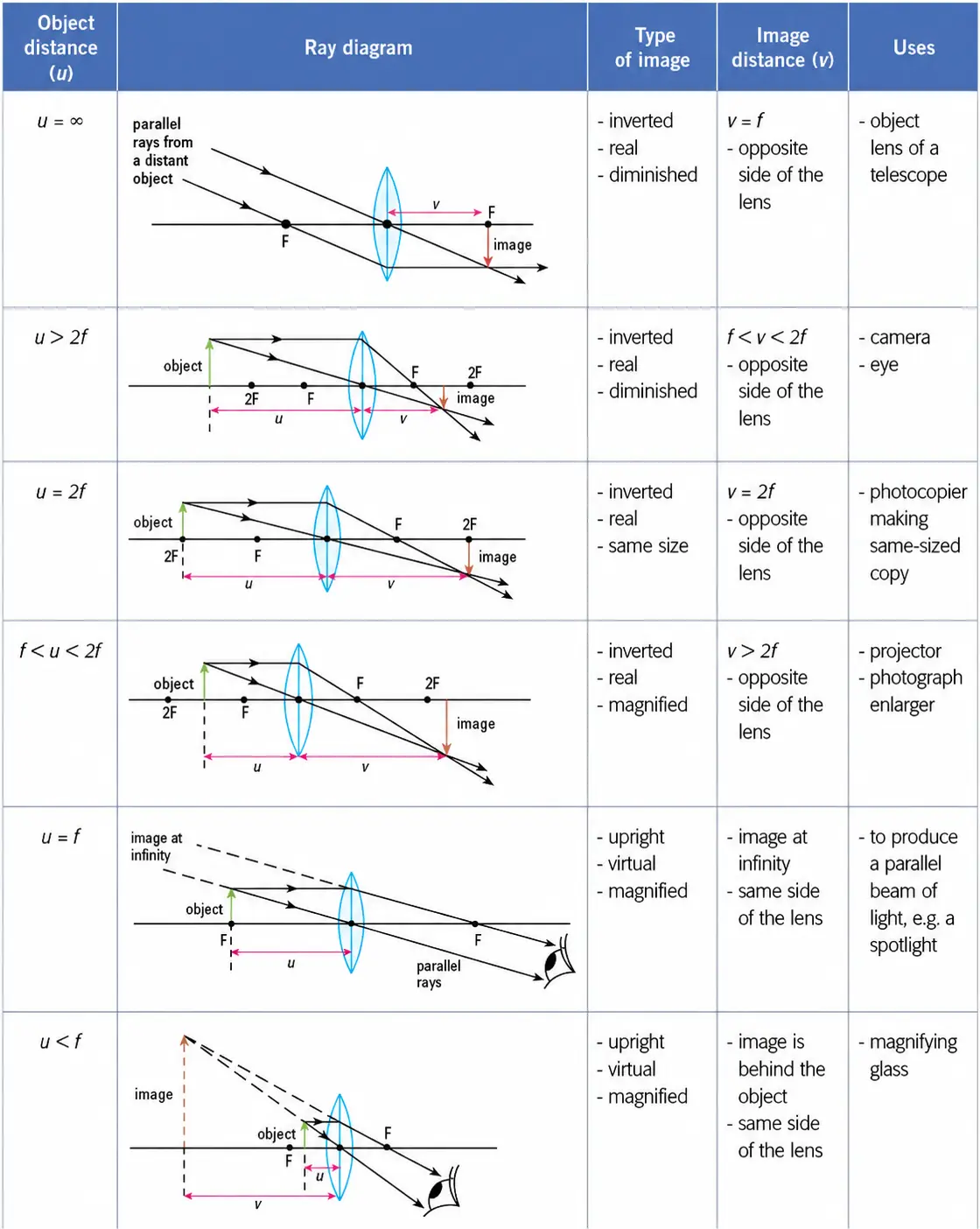
| Object position | Image type | Image location | Characteristics |
|---|---|---|---|
| Beyond | Real | Between and (other side) | Inverted, diminished |
| At | Real | At (other side) | Inverted, same size |
| Between and | Real | Beyond (other side) | Inverted, magnified |
| At | No image | At infinity | (rays emerge parallel) |
| Inside | Virtual | Same side as object | Upright, magnified |
A real image is formed where refracted rays actually converge, it can be projected onto a screen. A virtual image cannot be projected, the eye traces rays backward to an apparent intersection.
Magnification
where is the image distance and is the object distance (both measured from the optical centre). For a real image, means magnified; means diminished. A virtual image from a converging lens has (magnifying glass).
The Lens Formula
Sign convention: distances measured from the optical centre are positive on the side to which light is refracted (the other side from the object for a real image). A virtual image gives a negative .
ExampleConverging lens image distance and magnification (2022 Paper 02, Q3)
An object is placed 15 cm in front of a converging lens of focal length 10 cm.
Image distance:
The image is 30 cm from the lens on the other side.
Magnification:
Nature: real, inverted, and magnified (twice the object height). The image is on the opposite side of the lens from the object.
ExampleConverging lens with object inside F (magnifying glass) (2015 Paper 02, Q6)
An object AB is placed 20 cm from a converging lens of focal length 10 cm.
The image is real, at the same distance as the object.
The image is real, inverted, and the same size as the object (object at ).
Applications of Lenses
| Application | Lens type | Use |
|---|---|---|
| Magnifying glass | Converging | Object inside , produces upright, magnified virtual image |
| Camera | Converging | Object beyond , produces real, inverted, diminished image on sensor |
| Projector | Converging | Object between and , produces real, inverted, magnified image on screen |
| Spectacles (long-sight) | Converging | Converges light before it enters the eye to focus on the retina |
| Spectacles (short-sight) | Diverging | Diverges light before the eye so the eye can focus it |
| Microscope | Two converging lenses | Objective lens forms a magnified real image; eyepiece magnifies it further |
Exam Tip
Use consistently. A common error is adding when you should subtract: rearrange carefully.
When describing the nature of an image, always state four things: real or virtual, upright or inverted, magnified or diminished (or same size), and on which side of the lens it lies.