Heat Transfer
Matthew Williams
||7 min readConductionConvectionCSEC PhysicsGreenhouse EffectHeat TransferPaper 01Paper 02RadiationSection B
The three modes of heat transfer, conduction, convection, and radiation, their mechanisms, surface factors affecting radiation, applications including the vacuum flask and solar water heater, and the greenhouse effect.
Thermal energy moves from a region of higher temperature to one of lower temperature by three mechanisms: conduction, convection, and radiation.
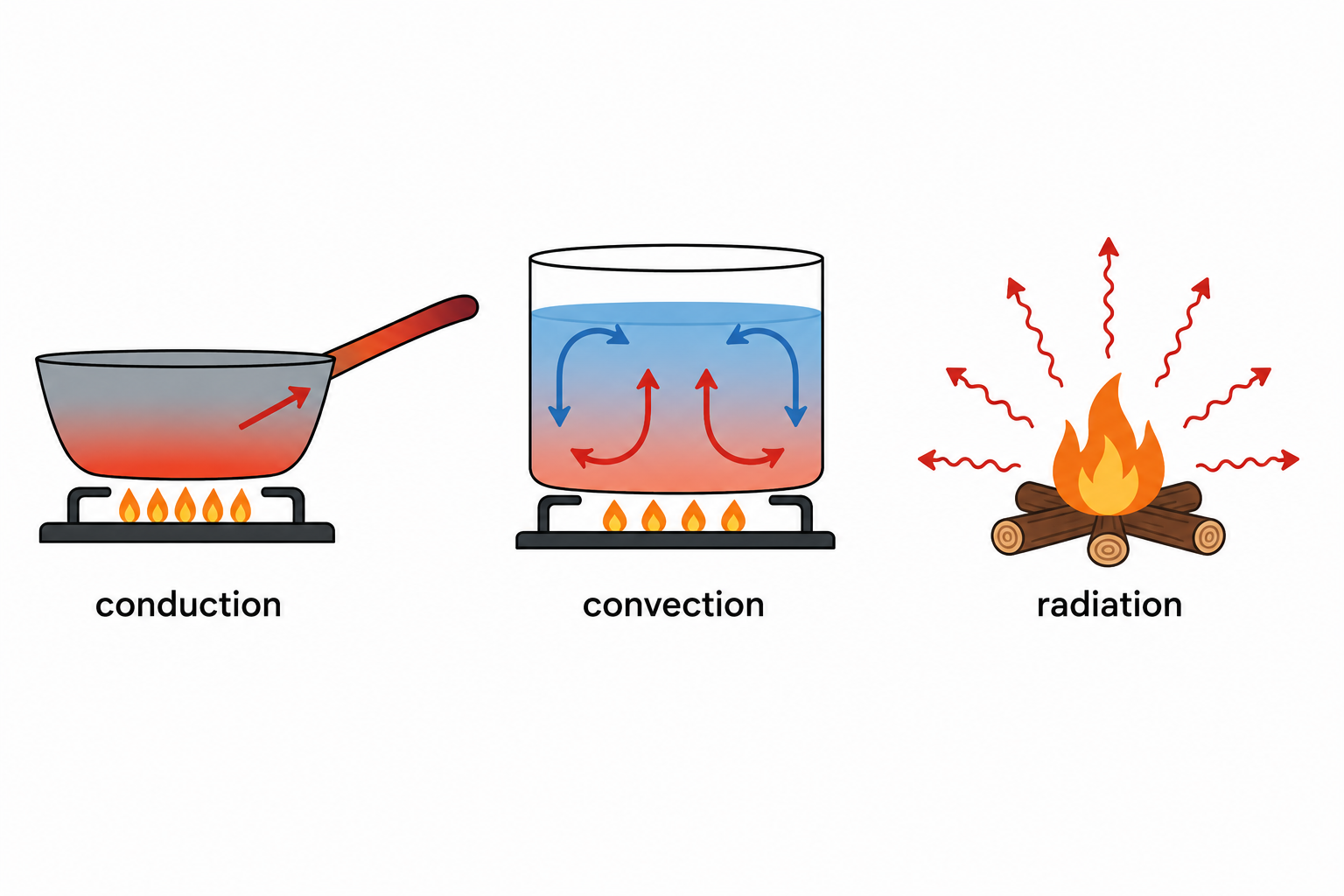
| Conduction | Convection | Radiation | |
|---|---|---|---|
| How energy moves | Particle vibration and free electron movement | Bulk movement of fluid | Electromagnetic (infrared) waves |
| Medium required | Yes | Yes | No — travels through vacuum |
| Physical contact needed | Yes | No | No |
| Occurs in | Solids mainly; poorly in liquids and gases | Liquids and gases only | Any medium or vacuum |
| Bulk movement of medium | No | Yes | No medium involved |
Conduction
Conduction is the transfer of thermal energy through a material by the vibration of particles and the movement of free electrons, without any bulk movement of the material itself.
Conduction transfers heat through a material without bulk movement of the material itself. In metals, free (conduction) electrons gain kinetic energy from the hot end and diffuse rapidly through the metal, transferring energy to cooler regions. In non-metals, energy is transferred by vibrations passing between adjacent atoms, this is slower, making non-metals poor conductors.
Conductors and insulators:
- Good conductors: metals (copper, aluminium, iron). Copper is used in heat exchangers, car radiators, and solar heater pipes because it conducts heat rapidly.
- Poor conductors (insulators): wood, glass, plastic, air, fibreglass. Insulators are used in building walls, clothing, and handles of cooking utensils.
Liquids and gases are generally poor conductors because their particles are more widely spaced. Air is a particularly good insulator when trapped (in double-glazed windows, foam, or expanded polystyrene).
Convection
Convection is the transfer of thermal energy through a fluid by the bulk movement of the fluid itself; warmer, less dense fluid rises and cooler, denser fluid sinks to replace it, forming a convection current.
Convection transfers heat through a fluid (liquid or gas) by the bulk movement of the fluid itself. When a fluid is heated, it expands, becomes less dense, and rises. Cooler, denser fluid sinks to take its place, creating a convection current.
Land and Sea Breezes
Convection currents at the coast produce daily wind patterns relevant to the Caribbean:
Sea breeze (daytime): The land heats up faster than the sea. Air above the land becomes warmer, expands, and rises. Cooler air from over the sea flows in to replace it, this is the sea breeze, experienced as a cooling breeze on Caribbean coasts during the day.
Land breeze (night-time): The land cools faster than the sea. Air above the sea is now warmer, rises, and air from the land flows out to replace it, a gentle breeze blowing from land toward the sea.
Radiation
Radiation is the transfer of thermal energy as infrared electromagnetic waves; it requires no medium and can travel through a vacuum.
Radiation transfers heat as electromagnetic waves (infrared radiation). Unlike conduction and convection, radiation does not require a medium, it travels through a vacuum. This is how the Sun's energy reaches Earth.
Factors Affecting Absorption and Emission of Radiation
The rate at which a surface absorbs or emits radiation depends on:
| Factor | Better emitter/absorber | Better reflector |
|---|---|---|
| Colour | Dark/black | Light/white |
| Texture | Dull/rough | Shiny/polished |
| Area | Large | Small |
A dull black surface is the best absorber and the best emitter of radiation. A shiny white surface is the poorest absorber (it reflects most radiation) and the poorest emitter.
Applications:
- Car radiator: should be dull black and have a large surface area so it emits heat quickly.
- Roof of a Caribbean home: should be white or light-coloured (to reflect solar radiation) and smooth (to reduce absorption), keeping the interior cool.
- Vacuum flask (thermos): reduces all three modes of heat loss, silvered walls reflect radiation, vacuum prevents conduction and convection, cork stopper reduces conduction through the neck.
ExampleSurface properties for radiation (2017 Paper 02, Q5)
Car radiator: The surface should be dull and black (or dark). A dull, black surface emits radiation most effectively, so the engine loses heat quickly, preventing overheating.
Roof of a Caribbean home: The surface should be white (light-coloured) and smooth. A white, smooth surface reflects most incoming solar radiation rather than absorbing it, so less heat enters the house and the interior stays cooler.
The Solar Water Heater and the Greenhouse Effect
The greenhouse effect is the process by which greenhouse gases in Earth's atmosphere (carbon dioxide, methane, and water vapour) absorb the long-wavelength infrared radiation emitted by Earth's surface and re-emit it in all directions, trapping heat that would otherwise escape into space and warming the lower atmosphere.
A solar water heater uses the same principle in miniature:
- The glass cover transmits short-wavelength solar radiation to the absorbing surface.
- The black absorbing surface heats up and emits longer-wavelength infrared radiation.
- Glass is opaque to this longer-wavelength radiation, so the energy is trapped inside the collector.
- Water circulating through copper pipes in the collector absorbs this heat.
In Earth's atmosphere, carbon dioxide, methane, and water vapour play the role of the glass: they absorb the long-wavelength infrared emitted by the Earth's surface and re-emit it in all directions, including back toward Earth. This natural greenhouse effect makes Earth habitable. The enhanced greenhouse effect occurs when burning fossil fuels raises CO₂ concentration, trapping more infrared radiation and contributing to global warming.
ExampleSolar water heater calculation (2024 Paper 02, Q3)
A solar water heater absorbs 360 kJ from the Sun. Thirty-five per cent of this energy is transferred to 1.5 kg of water (specific heat capacity 4200 J kg⁻¹ °C⁻¹) initially at 30 °C. Calculate the final temperature.
Energy transferred to water:
Temperature rise:
Final temperature:
Exam Tip
Be precise about which mode of heat transfer operates in a given situation:
- Conduction, through solid materials, by particle vibration and free electrons. No bulk movement.
- Convection, through fluids only (liquids and gases). Hot fluid rises; cool fluid sinks.
- Radiation, through any medium or vacuum. Does not require matter. Always involves infrared (electromagnetic) waves.
For radiation surface questions, state both the property (colour, texture) and the reason (absorbs/reflects/emits radiation better/worse).