Domestic Electricity
Matthew Williams
||5 min readCircuit BreakerCSEC PhysicsDomestic ElectricityEarth WireFusePaper 01Paper 02SafetySection D
Parallel wiring of domestic appliances, the purpose of fuses and circuit breakers, how to select the correct fuse rating, the earth wire and its protective function, and the effects of incorrect voltage on appliances.
Why Appliances Are Wired in Parallel
All domestic appliances are connected in parallel across the mains supply:
- Each appliance receives the full mains voltage (e.g. 110 V in Trinidad and Tobago; 220-240 V in many other countries).
- Each appliance can be switched on or off independently without affecting others.
- If one appliance develops a fault, the others continue to work.
The Three-Pin Plug and Its Wires
In a three-pin plug, three wires connect the appliance to the mains:
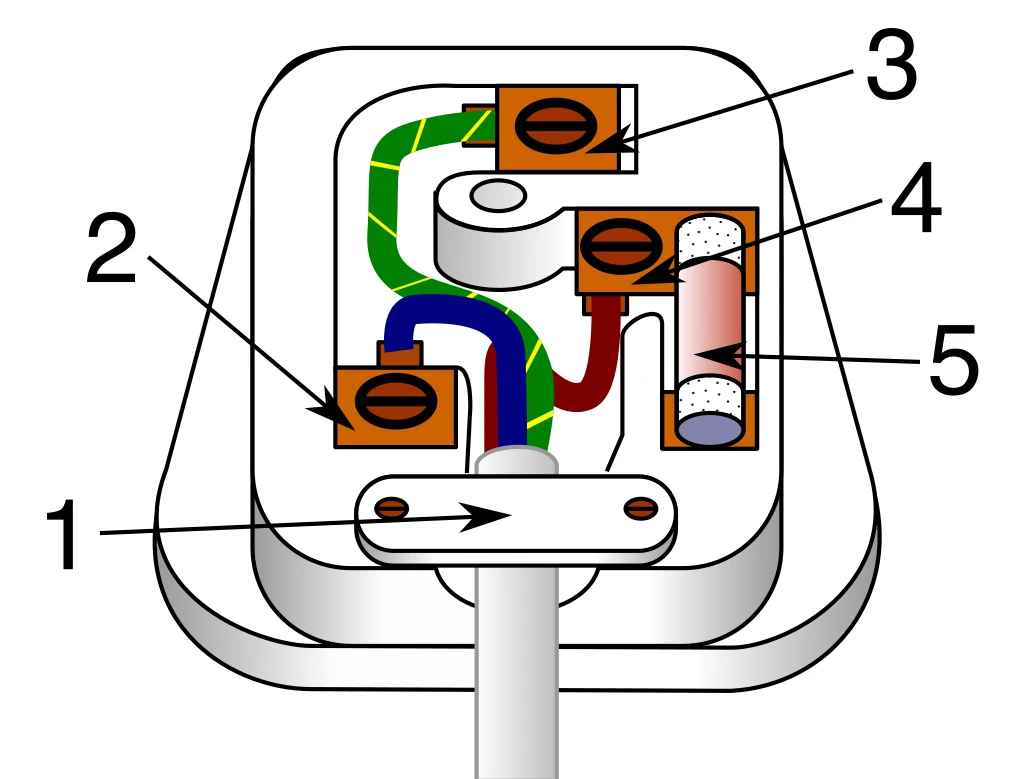
Key1.Cable grip2.Neutral terminal (blue wire)3.Earth terminal (green/yellow wire)4.Live terminal (brown wire)5.Fuse
| Wire | Colour (international) | Function |
|---|---|---|
| Live (L) | Brown | Carries current to the appliance at mains voltage |
| Neutral (N) | Blue | Completes the circuit; at approximately 0 V |
| Earth (E) | Green/yellow | Safety wire: connects metal casing to earth (0 V) |
The earth wire protects against electric shock. If the live wire inside the appliance breaks and touches the metal casing, the casing could become live (dangerous). The earth wire provides a low-resistance path directly to ground, a large current flows, which blows the fuse and cuts off the supply before anyone can be harmed.
Fuses and Circuit Breakers
A fuse is a thin wire made of metal with a low melting point. It is connected in series in the live wire. If too much current flows (e.g. due to a fault), the fuse wire heats up and melts, breaking the circuit and protecting the appliance and wiring.
Selecting the correct fuse rating: always choose the fuse rated just above the normal operating current. If a 5 A fuse blows too easily, check the appliance rating before fitting a higher-rated fuse.
Circuit breakers serve the same purpose as fuses but can be reset (switched back on) after tripping, whereas blown fuses must be replaced. Residual current devices (RCDs) detect imbalance between live and neutral current and cut off the supply very rapidly, protecting against electrocution.
ExampleChoosing the correct fuse
A hairdryer is rated 1200 W at 240 V. Find the operating current and choose an appropriate fuse from 3 A, 5 A, and 13 A options.
Operating current:
The fuse must be rated just above 5 A: choose the 13 A fuse. (The 5 A fuse would blow immediately at normal use since the hairdryer draws exactly 5 A and may momentarily draw more on startup.)
Effects of Incorrect Voltage
| Situation | Effect on appliance |
|---|---|
| Voltage too high | Excess current damages or burns out windings, elements, or components; overheating |
| Voltage too low | Appliance operates below its design power, motor runs slowly, heating elements produce less heat; may cause motors to draw more current and overheat |
Always check appliance voltage rating before connecting to a supply.
Exam Tip
The fuse and the switch are always placed in the live wire, never in the neutral. If a switch or fuse is in the neutral wire, the appliance may be electrically isolated from the circuit but the live terminal is still connected and remains dangerous.
The earth wire does not normally carry current, it only carries current if a fault develops.