Atomic Models and Structure
Matthew Williams
||5 min readAtomic ModelsBohrCSEC PhysicsIsotopesNucleusPaper 01Paper 02RutherfordSection E
The development of atomic models from Thomson through Rutherford to Bohr, the Geiger-Marsden gold foil experiment, the nuclide notation and its meaning, isotopes, and the electron shell model.
The Development of Atomic Models
Thomson's Model (1897), the "Plum Pudding"
J.J. Thomson discovered the electron. He proposed that an atom was a sphere of uniformly distributed positive charge with electrons embedded throughout it, like raisins in a pudding. This model predicted that alpha particles fired at atoms would pass through or be deflected by only small amounts.
The Geiger-Marsden Experiment (1909)
Rutherford directed Geiger and Marsden to fire alpha particles at a thin gold foil and detect where they landed:
- Expected (if Thomson correct): almost all particles pass straight through; minor small-angle scattering.
- Observed: most particles did pass straight through; but some were deflected through large angles, and a few bounced almost directly back.
Rutherford famously said it was "as if you fired a 15-inch shell at tissue paper and it came back and hit you."
Conclusion: most of the atom is empty space; positive charge and most of the mass are concentrated in a tiny, dense nucleus. Electrons orbit the nucleus in the surrounding empty space.
Rutherford's Nuclear Model (1911)
Rutherford proposed the atom as a miniature solar system: a tiny, dense, positively charged nucleus at the centre, with electrons orbiting it like planets around the Sun. The nucleus diameter is about times the atom diameter.
Bohr's Model (1913)
Niels Bohr modified Rutherford's model by proposing that electrons occupy specific energy levels called shells or orbits. Electrons in a shell have a fixed energy and do not radiate energy as long as they remain in that shell. When an electron jumps to a lower shell, it emits energy as light of a specific frequency.
Chadwick's Discovery of the Neutron (1932)
James Chadwick confirmed the existence of the neutron, an uncharged particle with nearly the same mass as a proton, inside the nucleus. This explained why nuclear masses were always greater than the number of protons alone would predict.
Structure of the Atom
| Particle | Charge | Relative mass | Location |
|---|---|---|---|
| Proton | +1 | 1 | Nucleus |
| Neutron | 0 | 1 | Nucleus |
| Electron | −1 | 1/1836 (negligible) | Shells surrounding nucleus |
The atom is electrically neutral: number of protons = number of electrons.
Nuclide Notation
where:
- is the chemical symbol of the element.
- is the atomic number (proton number), number of protons.
- is the mass number (nucleon number), total number of protons + neutrons.
Number of neutrons: .
Example: has 20 protons, 20 neutrons, and (as a neutral atom) 20 electrons.
ExampleNuclide structure (2024 Paper 02, Q6 and 2019 Paper 02, Q6)
Lithium-7 ():
- Protons:
- Neutrons:
- Electrons (neutral atom): 3
Radium-226 ():
- Protons: 88
- Neutrons:
Isotopes
Isotopes are atoms of the same element (same ) with different numbers of neutrons (different ). Isotopes have identical chemical properties but different nuclear properties.
Examples:
- Hydrogen: , (deuterium), (tritium).
- Carbon: (stable), (radioactive, used in dating).
- Uranium: (fissile) and .
The Electron Shell Model
Electrons are arranged in shells around the nucleus. Each shell can hold a maximum number of electrons:
| Shell | Maximum electrons | Energy level |
|---|---|---|
| First (K) | 2 | Lowest |
| Second (L) | 8 | Second |
| Third (M) | 18 | Third |
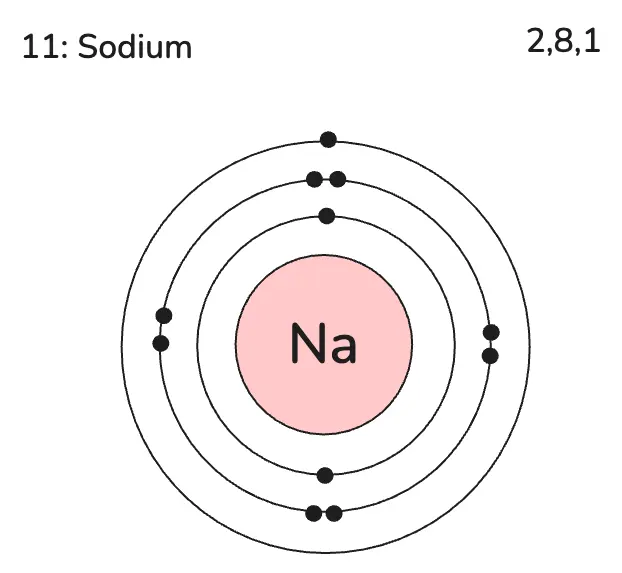
The first two shells give electronic configurations for elements up to calcium. For example, sodium (Na, ): 2, 8, 1, the outermost electron is responsible for sodium's chemistry.
Exam Tip
For any nuclide question: protons = Z (bottom number), neutrons = A − Z, electrons = Z (for a neutral atom). Mass number (A) is always the top number.
Isotopes have the same Z (same element) but different A (different neutron count). They behave identically chemically.