Mixtures and Separation
Matthew Williams
||11 min readCSEC ChemistryMixturesPaper 01Paper 02Section ASeparation TechniquesSolubilitySolutions
Pure substances and mixtures, homogeneous and heterogeneous mixtures, solutions, solubility, and separation techniques including filtration, distillation, crystallisation, and chromatography.
Matter can be classified into two main groups: pure substances and mixtures.
A pure substance contains only one type of material and has fixed properties, while a mixture consists of two or more substances physically combined in variable proportions. Understanding this distinction is essential, as it determines how substances behave and how they can be separated.
Pure Substances and Mixtures
A pure substance has a fixed composition and constant properties. It cannot be separated into simpler substances by physical means. Pure substances are divided into elements and compounds.
An element is the simplest form of matter and consists of only one type of atom. It cannot be broken down by ordinary chemical or physical methods. Examples include iron, copper, and oxygen.
A compound consists of two or more different elements chemically combined in fixed proportions. Its properties differ from those of the individual elements. For example, water is composed of hydrogen and oxygen, but its properties are very different from those gases.
A mixture, in contrast, consists of substances that are not chemically combined. Each component retains its own properties and can be separated by physical methods. The composition of a mixture is not fixed.
Homogeneous and Heterogeneous Mixtures
Mixtures can be further classified based on their uniformity.
A homogeneous mixture has a uniform composition throughout, and its components cannot be distinguished. A solution is a common example, such as salt dissolved in water or air.
A heterogeneous mixture has a non-uniform composition, and its components can be distinguished. Examples include sand and salt or muddy water.
Solutions, Suspensions, and Colloids
Different types of mixtures can be distinguished based on particle size and behaviour.
-
Solution: A homogeneous mixture in which a solute is dissolved in a solvent. The particles are very small, do not settle, and cannot be separated by filtration. Solutions are usually transparent.
-
Suspension: A heterogeneous mixture containing visible particles. These particles settle over time and can be separated by filtration.
-
Colloid: A heterogeneous mixture with particles intermediate in size between those of a solution and a suspension. The particles do not settle but can scatter light.
| Property | Solution | Colloid | Suspension |
|---|---|---|---|
| Type of mixture | Homogeneous | Heterogeneous | Heterogeneous |
| Particle size | Very small (<1 nm) | Intermediate (1–1000 nm) | Large (>1000 nm) |
| Can be seen by naked eye | No | No | Yes |
| Settles over time | No | No | Yes |
| Can be separated by filtration | No | No | Yes |
| Scatters light (Tyndall effect) | No | Yes | Yes |
| Appearance | Transparent | Cloudy or translucent | Cloudy or opaque |
| Example | Salt water | Milk, fog | Muddy water, chalk in water |
These differences arise from particle size and how particles interact with the surrounding medium.
Solubility
Solubility is the mass of solute that can dissolve in a fixed amount of solvent at a given temperature, usually expressed as grams per 100 g of water.
A solution becomes saturated when it contains the maximum amount of solute that can dissolve at a given temperature. Any additional solute remains undissolved.
For most solid solutes in water, solubility increases as temperature increases. When a saturated solution is cooled, excess solute may crystallise out.
Types of Solutions
Solutions are not limited to a solid dissolved in a liquid. Any two substances can potentially form a solution, depending on their compatibility:
| Type | Example |
|---|---|
| Solid in liquid | Salt dissolved in water |
| Liquid in liquid | Ethanol dissolved in water |
| Gas in liquid | Carbon dioxide dissolved in water (fizzy drinks) |
| Solid in solid | Brass (copper and zinc — a solid alloy) |
| Gas in gas | Air (nitrogen, oxygen, and other gases) |
The most common solutions encountered in chemistry are solids or gases dissolved in a liquid solvent.
Industrial Extraction of Sucrose from Sugar Cane
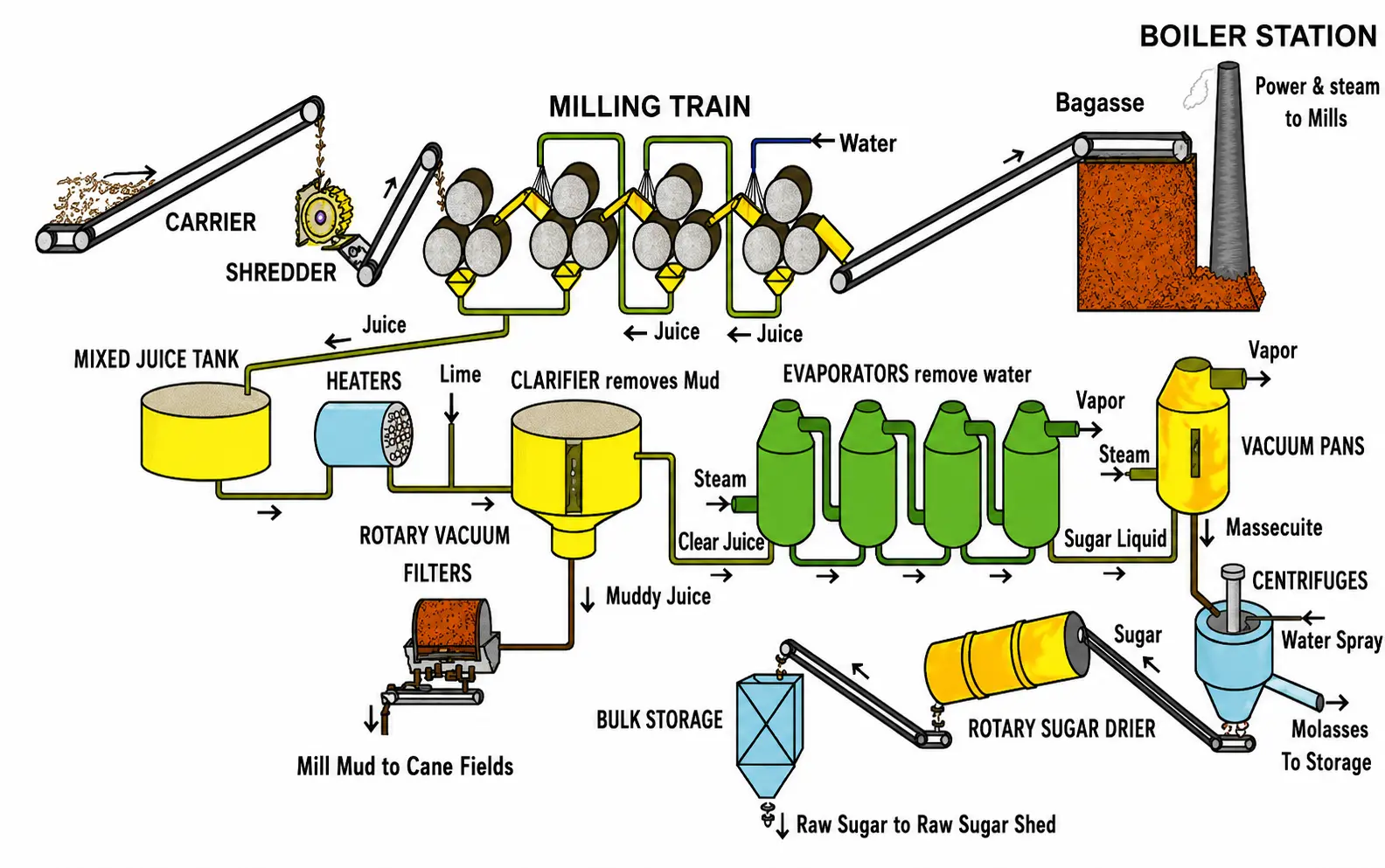
The extraction of sucrose from sugar cane is an important Caribbean industrial process that chains several separation techniques together.
-
Harvesting — sugar cane is cut and transported to the factory.
-
Cutting — rotating knives on a feeder table chop the cane into smaller pieces to prepare it for crushing.
-
Crushing — the chopped cane passes through heavy roller mills. Water is sprayed onto the cane as it is crushed, dissolving the sucrose and producing a dilute juice. The fibrous solid left behind is called bagasse. Bagasse is burned in furnaces to generate the steam and heat that power the factory.
-
Precipitation and sedimentation — the dilute juice enters settling tanks. Lime (calcium hydroxide) is added for two reasons: it causes impurities to precipitate so they settle out, and it neutralises the naturally acidic juice to prevent sucrose from decomposing.
-
Filtration — rotary filters remove the muddy precipitate from the juice. The mud is washed to recover any remaining sucrose; the factory mud is often returned to fields as fertiliser.
-
Vacuum evaporation — the clarified juice passes through boilers or evaporators operating under reduced pressure. Water evaporates at a lower temperature than normal, concentrating the juice into a thick syrup without decomposing the sucrose.
-
Crystallisation — the syrup enters a vacuum pan, where sugar crystals form at low pressure. The resulting mixture of crystals suspended in molasses is called massecuite.
-
Centrifugation — the massecuite is spun in centrifuges. The force drives the molasses through the perforated walls of the drum, leaving raw sugar crystals behind. Molasses may be recycled for further crystallisation or used in rum, alcohol production, and animal feed.
Exam Tip
Know the full sequence: harvesting → cutting → crushing → precipitation and sedimentation → filtration → vacuum evaporation → crystallisation → centrifugation. Know what bagasse is and what it is used for. Know the two purposes of adding lime. Know that the crystal-molasses mixture is called massecuite.
Separating Mixtures
Mixtures can be separated because their components have different physical properties such as particle size, boiling point, density, and solubility.
-
Filtration: Used to separate an insoluble solid from a liquid. The solid remains as the residue, while the liquid passes through as the filtrate.
-
Evaporation: Used to obtain a dissolved solid by heating the solution so that the solvent evaporates.
-
Crystallisation: Used to obtain a solid in crystalline form by allowing the solvent to evaporate slowly.
-
Simple distillation: Used to separate a liquid from a solution. The liquid is vaporised and then condensed to form the distillate.
-
Fractional distillation: Used to separate two or more miscible liquids with different boiling points.
-
Separating funnel: Used to separate immiscible liquids based on differences in density.
-
Chromatography: Used to separate dissolved substances based on differences in solubility and attraction to a medium.
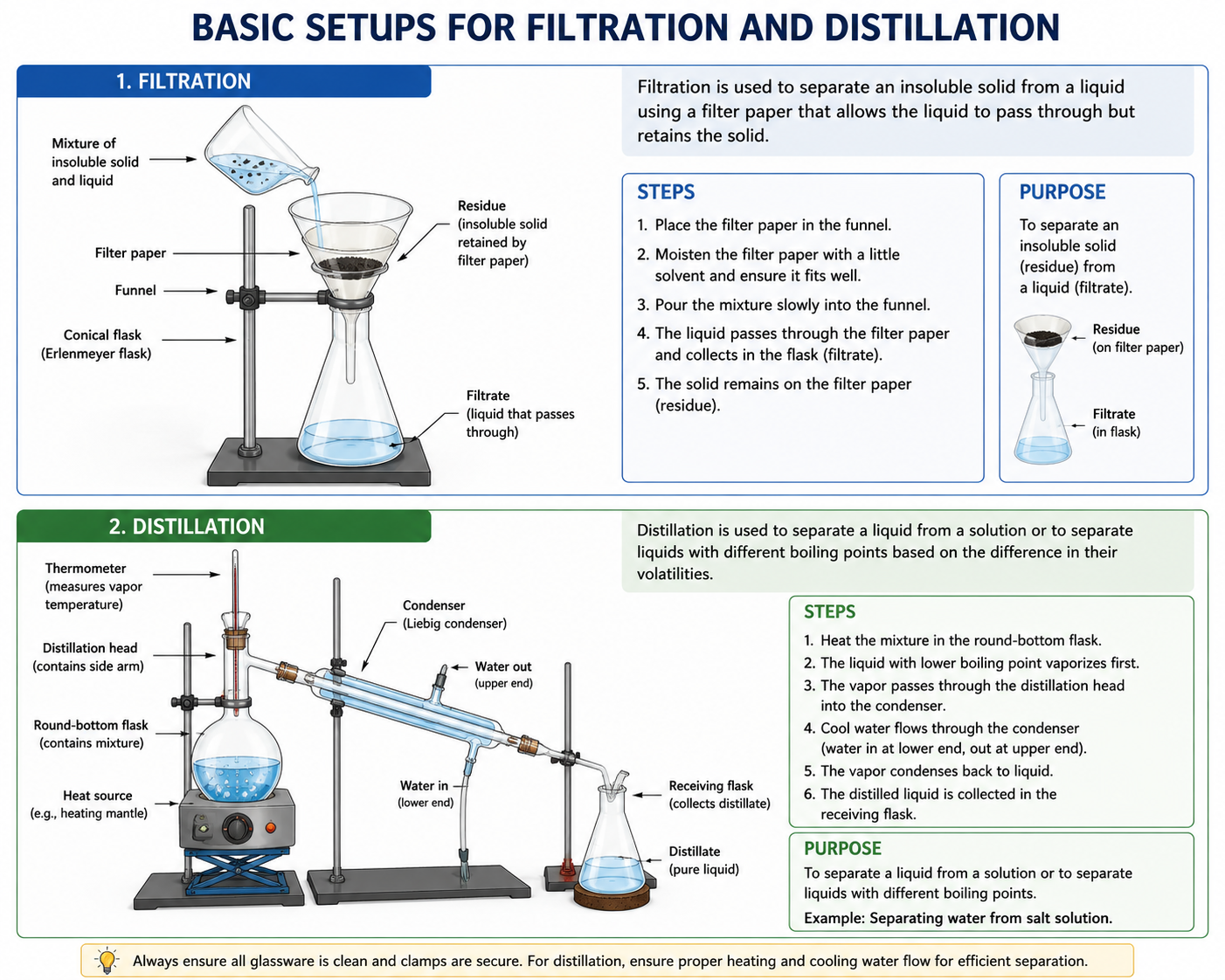
Each method depends on a specific physical property, so choosing the correct method requires identifying how the components differ.