Respiration and Gas Exchange
Matthew Williams
||8 min read|BreathingCSEC BiologyGas ExchangeRespirationSection BSmoking
Aerobic and anaerobic respiration, ATP, the breathing mechanism, gas exchange surfaces, gaseous exchange in plants, and the effects of smoking.
Every living cell needs energy to carry out its processes. Respiration is the set of chemical reactions that releases this energy from food molecules. It should not be confused with breathing — breathing is the physical movement of air in and out of the lungs, while respiration is the biochemical process that happens inside cells.
Aerobic Respiration
Aerobic respiration uses oxygen to break down glucose completely, releasing a large amount of energy. It takes place mainly in the mitochondria.
Word equation:
glucose + oxygen → carbon dioxide + water (+ energy released as ATP)
Balanced chemical equation:
C₆H₁₂O₆ + 6O₂ → 6CO₂ + 6H₂O
ATP
ATP (adenosine triphosphate) is the molecule that transfers energy within cells. When a cell needs energy, ATP is broken down to ADP, releasing usable energy at the site where it is needed. Cells use ATP for:
- muscle contraction
- active transport across membranes
- protein synthesis
- cell division
- nerve impulse transmission
- maintaining body temperature
Aerobic respiration produces far more ATP per glucose molecule than anaerobic respiration.
Anaerobic Respiration
Anaerobic respiration releases energy from glucose without oxygen. The yield of ATP is much lower than aerobic respiration, and waste products accumulate.
| In animal muscle cells | In yeast | |
|---|---|---|
| Equation | glucose → lactic acid | glucose → ethanol + carbon dioxide |
| ATP yield | small | small |
| Waste product | lactic acid | ethanol + CO₂ |
| Application | sprinting, heavy exercise | bread-making, brewing |
During intense exercise, muscles may not receive oxygen quickly enough. Anaerobic respiration provides ATP temporarily, but lactic acid builds up. This causes muscle fatigue and pain. After exercise, extra oxygen is consumed to break down lactic acid — this extra oxygen consumption is called the oxygen debt.
Yeast fermentation is used industrially: carbon dioxide from fermentation makes bread rise, and ethanol produced during fermentation is the basis of alcoholic beverages.
Aerobic vs Anaerobic Comparison
| Feature | Aerobic | Anaerobic |
|---|---|---|
| Oxygen required | yes | no |
| Glucose fully broken down | yes | no |
| ATP produced | large amount | small amount |
| Waste products | CO₂ and water | lactic acid (animals) or ethanol + CO₂ (yeast) |
| Location | mitochondria | cytoplasm |
| Duration | sustained | short-term only |
Gas Exchange Surfaces
Gas exchange is the movement of respiratory gases (oxygen and carbon dioxide) between an organism and its environment. For efficient diffusion, gas exchange surfaces share common features:
| Feature | Why it matters |
|---|---|
| Large surface area | allows more gas to diffuse simultaneously |
| Thin walls | short diffusion distance |
| Moist surface | gases dissolve before diffusing through the membrane |
| Good blood supply (in animals) | maintains steep concentration gradient; carries gases away quickly |
| Ventilation | replaces stale air to maintain gradient (in air-breathing organisms) |
Human Gas Exchange
The Respiratory System
Air passes through: nasal cavity → pharynx → larynx → trachea → bronchi → bronchioles → alveoli.
The trachea has C-shaped rings of cartilage that keep it open. It is lined with ciliated epithelium and mucus-producing goblet cells — cilia sweep mucus and trapped particles upward toward the throat.
The alveoli are the site of gas exchange in the lungs. Each alveolus is a tiny air sac surrounded by capillaries.
Breathing Mechanism
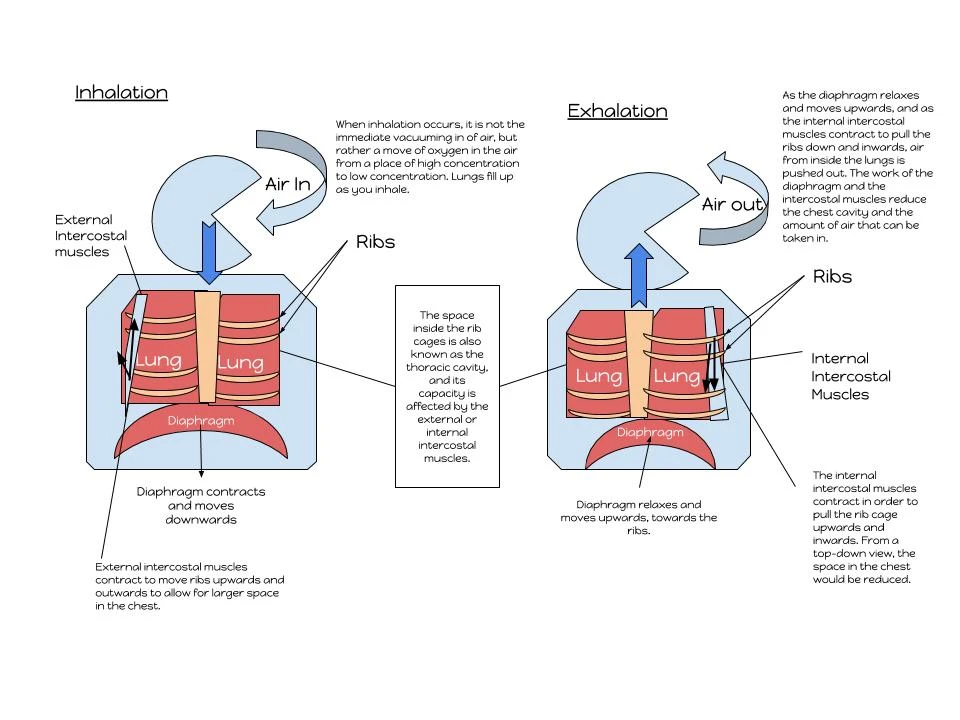
Breathing is the physical process of moving air into and out of the lungs, controlled by the diaphragm and intercostal muscles.
| Stage | Diaphragm | Intercostal muscles | Chest volume | Pressure | Air movement |
|---|---|---|---|---|---|
| Inhalation | contracts (flattens) | contract (ribs move up and out) | increases | decreases | air flows in |
| Exhalation | relaxes (domes up) | relax (ribs move down and in) | decreases | increases | air flows out |
Air moves from high pressure to low pressure — the same principle as diffusion, but at the level of the whole lung.
For more detail, the external intercostal muscles contract during inhalation to move the ribs up and out. During forced exhalation, the internal intercostal muscles contract to pull the ribs down and in. The diaphragm is not in the ribcage, but it is the main breathing muscle.
Composition of Air
| Gas | Inhaled | Exhaled |
|---|---|---|
| Oxygen | ~21% | ~16% |
| Carbon dioxide | ~0.04% | ~4% |
| Nitrogen | ~78% | ~78% |
| Water vapour | low (variable) | high (saturated) |
The differences reflect gas exchange at the alveoli: oxygen is absorbed and carbon dioxide is added. Nitrogen is not used.
Effects of Smoking
Tobacco smoke contains hundreds of harmful substances. The three most important for CSEC are nicotine, tar, and carbon monoxide.
| Substance | Effects |
|---|---|
| Nicotine | addictive; raises heart rate and blood pressure; constricts blood vessels |
| Tar | settles in airways; contains carcinogens (cancer-causing chemicals); paralyses cilia so mucus accumulates |
| Carbon monoxide | binds to haemoglobin irreversibly, reducing oxygen-carrying capacity of blood |
Smoking-related diseases
| Disease | Description |
|---|---|
| Chronic bronchitis | inflammation of the airways; excess mucus production; persistent cough; cilia damaged by tar cannot clear mucus |
| Emphysema | alveoli walls break down; fewer, larger air spaces; greatly reduced surface area; shortness of breath |
| Lung cancer | carcinogens in tar cause uncontrolled cell division in lung tissue |
| Cardiovascular disease | nicotine and carbon monoxide damage blood vessels and reduce oxygen delivery; increases risk of heart attack and stroke |
Remember
Tar damages cilia → mucus builds up → bacteria are not cleared → risk of infection increases. This cycle explains smoker's cough and increased susceptibility to chest infections.
Gas Exchange in Plants
Plants exchange gases through stomata — pores mainly on the lower surface of leaves, controlled by guard cells. Guard cells change shape when they gain or lose water, opening or closing the stomatal pore.
During the day (when photosynthesis is active):
- CO₂ diffuses in through stomata for photosynthesis
- O₂ produced by photosynthesis diffuses out
- Water vapour also diffuses out (transpiration)
At night (no photosynthesis, only respiration):
- O₂ diffuses in for respiration
- CO₂ produced by respiration diffuses out
The spongy mesophyll layer has large air spaces that allow gas to circulate between cells before reaching the stomata.
Exam Tip
A common exam question asks whether a plant photosynthesises or respires at night. Plants respire continuously — day and night. During bright daylight, photosynthesis is much faster than respiration, so the net effect is CO₂ uptake. At night there is no photosynthesis, so only respiration occurs.