Nutrition in Plants
Matthew Williams
||7 min read|CSEC BiologyNutritionPhotosynthesisPlantsSection B
Autotrophic, heterotrophic, and saprophytic nutrition, photosynthesis, leaf structure, limiting factors, and mineral nutrition in plants.
Nutrition is how organisms obtain the raw materials and energy they need to survive. Green plants are the foundation of almost every food chain because they can manufacture their own food from simple inorganic substances using light energy.
Types of Nutrition
| Type | Description | Examples |
|---|---|---|
| Autotrophic | organism makes its own organic food from inorganic substances using an external energy source | green plants, algae, some bacteria |
| Heterotrophic | organism obtains organic food by consuming other organisms | animals, most fungi, most bacteria |
| Saprophytic | organism obtains nutrients by secreting enzymes onto dead or decaying matter and absorbing the products | fungi, many bacteria |
Holozoic nutrition is a type of heterotrophic nutrition in which organisms ingest whole food, digest it internally, and absorb the products — the pattern seen in humans and most animals.
Photosynthesis
Photosynthesis is the process by which green plants use light energy to convert carbon dioxide and water into glucose and oxygen.
Word equation:
carbon dioxide + water → glucose + oxygen (in the presence of light and chlorophyll)
Balanced chemical equation:
6CO₂ + 6H₂O → C₆H₁₂O₆ + 6O₂
Photosynthesis has two broad stages:
- the light-dependent stage — light energy splits water, releasing oxygen and producing ATP
- the light-independent stage — ATP is used to fix carbon dioxide into glucose
For CSEC, the key understanding is the overall equation, the raw materials, the products, and the conditions needed.
Remember
Photosynthesis uses CO₂ and H₂O to produce glucose and O₂. Respiration does the opposite. Both happen simultaneously in plant cells, but photosynthesis dominates in bright light.
What plants do with glucose
Plants do not just accumulate glucose. They use it in several ways:
- respiration — releases energy for growth, transport, and reproduction
- converted to starch for storage (in seeds, roots, stems)
- converted to sucrose for transport through the phloem
- used to build cellulose for cell walls
- combined with nitrates to make amino acids and proteins
- converted to fats and oils for storage in seeds
Leaf Structure and Photosynthesis
The leaf is the main organ of photosynthesis. Its structure is closely matched to this function.
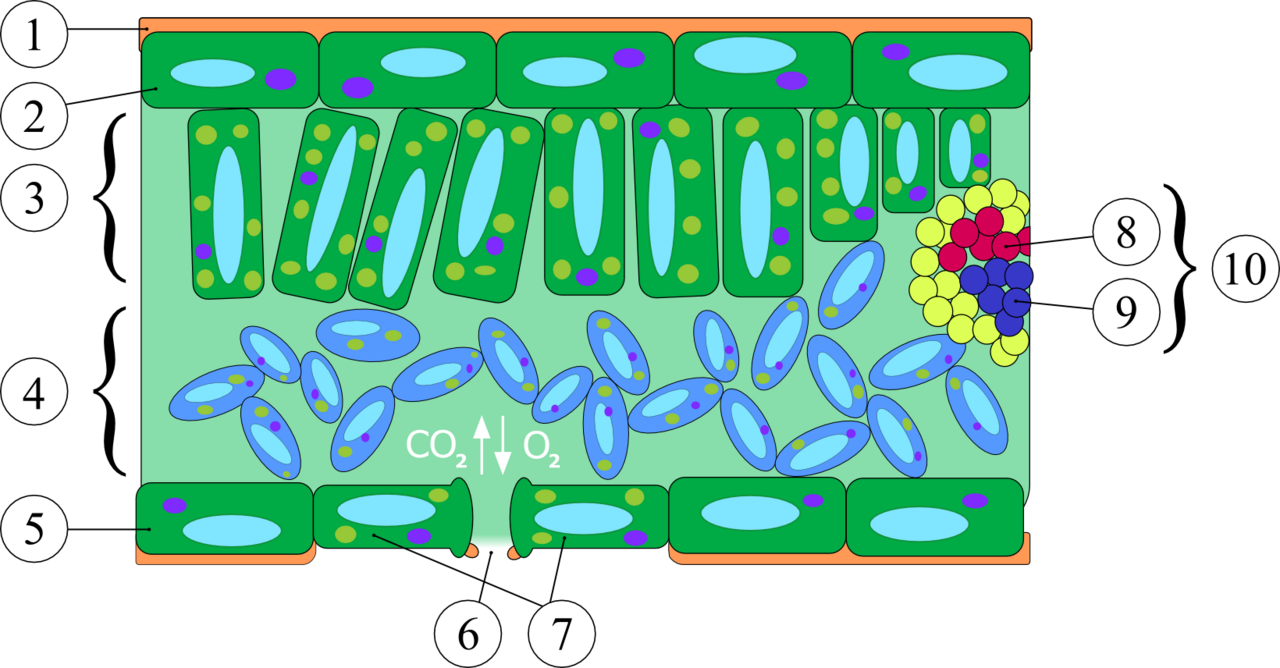
Key1.Upper epidermis2.Palisade mesophyll3.Chloroplasts4.Spongy mesophyll5.Lower epidermis6.Stomata7.Guard cells8.Xylem9.Phloem10.Vascular bundle
| Feature | Adaptation |
|---|---|
| Broad, flat shape | maximises surface area for light absorption |
| Thin structure | reduces diffusion distance for CO₂ and O₂ |
| Transparent upper epidermis | allows light through to the palisade layer |
| Palisade mesophyll cells | tall, closely packed, rich in chloroplasts; positioned near the top for maximum light |
| Spongy mesophyll | large air spaces for gas exchange; CO₂ diffuses to palisade cells |
| Stomata (lower epidermis) | pores for gas exchange; CO₂ enters, O₂ and water vapour leave |
| Guard cells | open and close stomata in response to light and water availability |
| Vascular bundle (midrib and veins) | xylem carries water to cells; phloem carries glucose away |
| Waxy cuticle | reduces water loss by evaporation |
Exam Tip
A leaf structure question often asks you to explain how a named feature is adapted for photosynthesis. Always state the feature, describe its structural property, and then link it to how photosynthesis benefits — for example: "The palisade cells are packed with chloroplasts, which absorb light energy for photosynthesis."
Limiting Factors of Photosynthesis
A limiting factor is any variable that, when in short supply, reduces the rate of photosynthesis even if other conditions are ideal. At any given moment, one factor is most limiting.
| Factor | How it limits photosynthesis |
|---|---|
| Light intensity | provides energy for the light-dependent stage; low light means less ATP produced |
| Carbon dioxide concentration | raw material for carbon fixation; low CO₂ reduces the rate even in bright light |
| Temperature | affects enzyme activity; too low slows reactions; too high denatures enzymes |
| Water availability | raw material split in the light-dependent stage; also needed for cell turgor |
In a greenhouse, growers can increase yield by raising CO₂ concentration and light intensity together, since increasing one alone eventually hits a ceiling set by the other.
Mineral Nutrition in Plants
Plants absorb mineral ions from soil water through their roots. These minerals are especially important at CSEC level:
Nitrogen
Nitrogen is needed to make:
- amino acids and proteins (for growth, enzymes, and cell membranes)
- nucleic acids (DNA and RNA)
- chlorophyll
Plants absorb nitrogen as nitrate ions (NO₃⁻) from the soil via active transport. Nitrogen-fixing bacteria in the soil and in root nodules of legumes also convert nitrogen gas into forms plants can use.
Deficiency effects: stunted growth, older leaves turn yellow (chlorosis), poor protein production.
Magnesium
Magnesium is needed to make chlorophyll — it is part of the chlorophyll molecule itself.
Deficiency effects: yellow leaves (chlorosis), particularly affecting younger leaves first; photosynthesis rate falls.
Calcium
Calcium is needed for strong cell walls and normal growth of young tissues. It helps cells stick together and supports root and shoot development.
Deficiency effects: poor growth, weak young leaves, and poor root development.
| Mineral | Role in plant | Deficiency symptom |
|---|---|---|
| Nitrogen | amino acids, proteins, DNA, chlorophyll | stunted growth, yellowing of older leaves |
| Magnesium | component of chlorophyll molecule | yellowing of leaves, reduced photosynthesis |
| Calcium | cell wall formation and normal growth | weak young tissues, poor root growth |
Exam Tip
Both nitrogen and magnesium deficiency cause yellowing, but nitrogen deficiency typically affects older leaves first (the plant relocates nitrogen to newer growth), while magnesium deficiency often shows in younger leaves too. Examiners may ask you to distinguish between them using symptom location.