Movement and Support
Matthew Williams
||6 min read|Rarely TestedCSEC BiologyLocomotionMusclesSection BSkeleton
The skeleton's functions, bone and cartilage, types of joints, antagonistic muscle action, and the importance of locomotion in animals.
Movement is one of the characteristics of living organisms, but it takes different forms in animals and plants. Animals move their whole body from place to place — this is locomotion. Plants respond to stimuli by growing in a particular direction — tropisms — covered in the coordination topic. This page focuses on how the human body achieves locomotion through the skeleton and muscles.
Functions of the Skeleton
The skeleton has five main roles:
| Function | How the skeleton achieves it |
|---|---|
| Support | provides a rigid framework that holds the body upright against gravity |
| Protection | encloses and shields vital organs (skull protects brain; ribcage protects heart and lungs; vertebral column protects spinal cord) |
| Movement | acts as a system of levers; bones move at joints when pulled by muscles |
| Blood cell production | red bone marrow in long bones produces red blood cells, white blood cells, and platelets |
| Mineral storage | calcium and phosphorus are stored in bone and released when needed |
Bone and Cartilage
Bone is a hard, living tissue made of calcium salts (mainly calcium phosphate) deposited on a protein (collagen) framework. It is strong, slightly flexible, and can be repaired.
Cartilage is a softer, more flexible connective tissue. It is found at the ends of bones (reduces friction in joints), in the ear and nose (shape without rigidity), and between vertebrae (absorbs shock).
| Feature | Bone | Cartilage |
|---|---|---|
| Hardness | hard and rigid | firm but flexible |
| Mineral content | high (calcium salts) | low |
| Blood supply | well supplied | poorly supplied (slow to heal) |
| Role in joints | forms the joint | covers the articulating surface |
Structure of a Long Bone
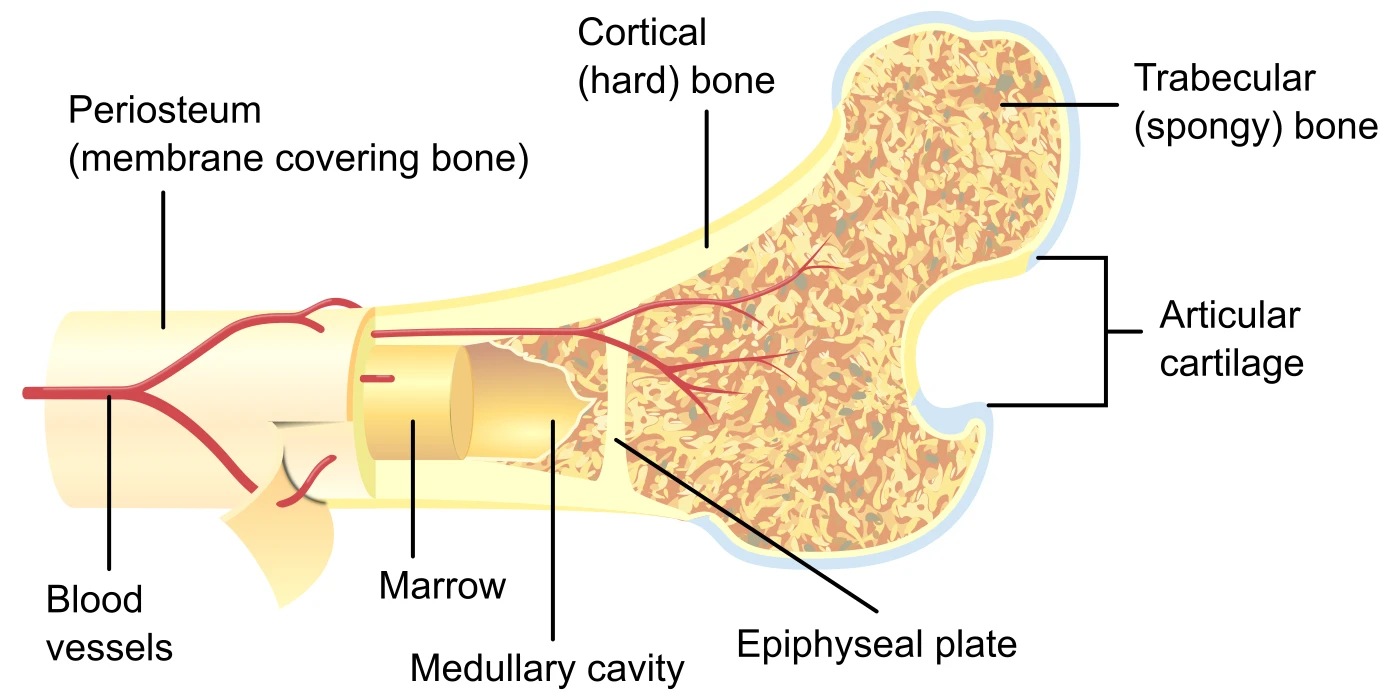
| Region | Description |
|---|---|
| Periosteum | tough membrane covering the outer surface; anchors tendons and ligaments |
| Compact (cortical) bone | dense outer layer; provides strength; withstands compressive forces |
| Spongy (trabecular) bone | lighter, porous inner layer at the ends (epiphyses); arranged along lines of stress |
| Medullary cavity | hollow shaft filled with yellow marrow (fat storage) |
| Red bone marrow | found in spongy bone; produces red blood cells, white blood cells, and platelets |
| Articular cartilage | smooth layer at the ends; reduces friction at joints |
| Epiphyseal plate | growth plate; allows the bone to lengthen during childhood |
Types of Joints
A joint is where two or more bones meet. Different joints allow different amounts of movement.
| Joint type | Movement | Example |
|---|---|---|
| Fixed (fibrous) | none | skull sutures |
| Slightly movable (cartilaginous) | limited | vertebrae of the spine (cartilage pads between) |
| Freely movable (synovial) | wide range | hip, knee, elbow, shoulder |
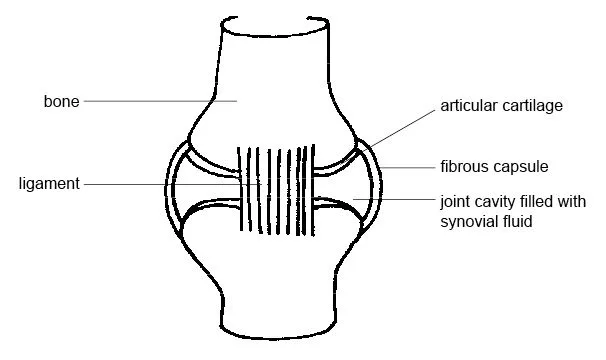
Synovial Joint Structure
Freely movable joints share a common plan:
- Cartilage on the ends of each bone — smooth surface; reduces friction
- Synovial membrane — produces synovial fluid
- Synovial fluid — lubricates the joint; acts as a shock absorber
- Joint capsule — tough fibrous covering; holds joint together
- Ligaments — strong bands of fibrous tissue connecting bone to bone; stabilise the joint
Antagonistic Muscles
Muscles can only pull, not push. Movement at a joint therefore requires at least two muscles that work in opposite directions — an antagonistic pair.
The classic example is the upper arm:
| Muscle | Action when contracting | Effect on forearm |
|---|---|---|
| Bicep (flexor) | contracts | forearm moves up (flexion) — arm bends |
| Tricep (extensor) | contracts | forearm moves down (extension) — arm straightens |
When the bicep contracts, the tricep relaxes, and vice versa. Tendons (which connect muscle to bone) transmit the pulling force across the joint.
Tendons connect muscle to bone and are made of inelastic collagen — they transmit force efficiently without stretching. Ligaments connect bone to bone and are slightly elastic, preventing dislocation while allowing movement.
Why Locomotion is Important
The ability to move from place to place gives animals major survival advantages:
- finding food (hunting, foraging, migrating to new food sources)
- escaping predators
- finding mates for reproduction
- moving away from harmful conditions (extreme temperature, pollutants)
- caring for offspring
- dispersing to new habitats
Plants, being rooted, achieve similar outcomes passively through growth tropisms, seed dispersal, and pollen transfer.
Remember
Muscles pull on bones by contracting. A single muscle can flex or extend a joint, but only one direction — a paired muscle provides the opposite movement. This is why antagonistic pairs are essential.