Human Reproduction
Matthew Williams
||7 min read|CSEC BiologyMenstrual CycleReproductionSection BSTIs
Sexual and asexual reproduction, male and female reproductive systems, the menstrual cycle, fertilisation, the placenta and amnion, contraception, and STIs.
Reproduction ensures the continuation of a species. Two fundamental strategies exist across living organisms.
Sexual and Asexual Reproduction
| Feature | Asexual reproduction | Sexual reproduction |
|---|---|---|
| Number of parents | one | two |
| Gametes involved | no | yes (male and female) |
| Genetic variation | none (offspring are clones) | yes (offspring are genetically unique) |
| Speed | usually faster | slower |
| Examples | budding, binary fission, runners, cuttings | mammals, flowering plants |
Asexual reproduction is advantageous in stable environments where the parent is well-adapted. Sexual reproduction produces variation, which is valuable when environments change.
Male Reproductive System
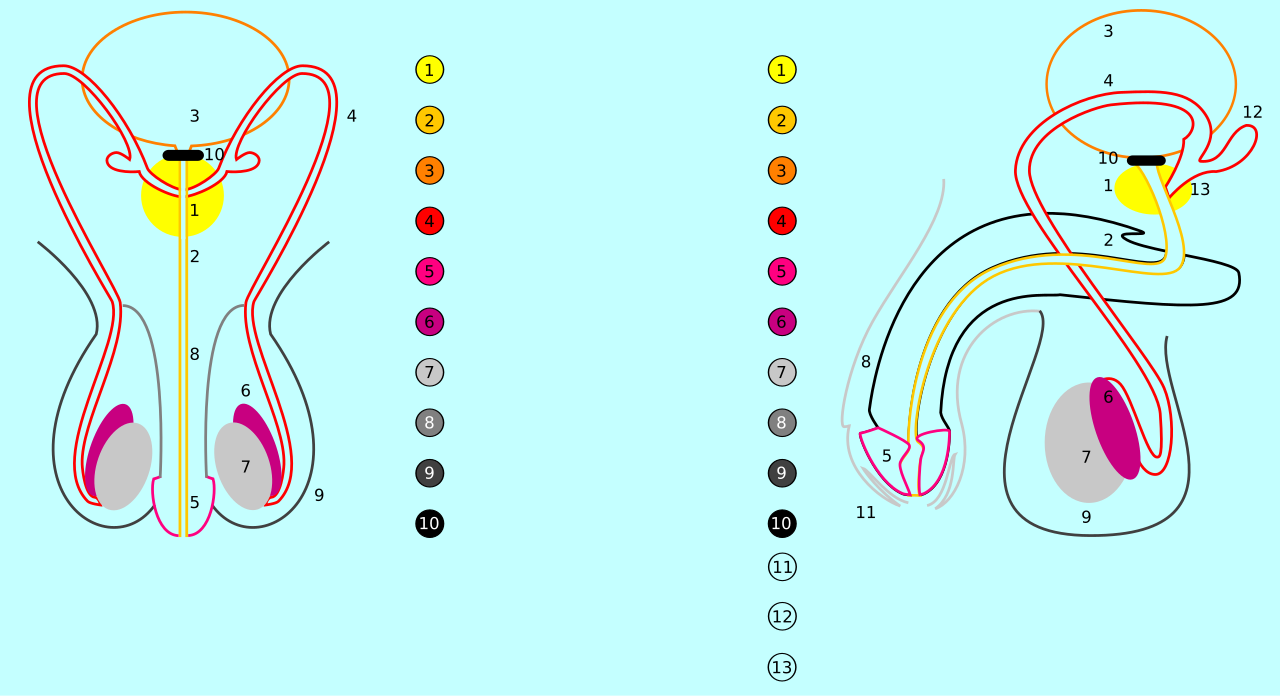
Key1.Urinary bladder2.Urethra3.Vas deferens (ductus deferens)4.Epididymis (head)5.Glans penis6.Epididymis (body)7.Testis8.Scrotum9.Prepuce (foreskin)10.Prostate gland11.Bulbourethral gland (Cowper's gland)12.Seminal vesicle13.Ejaculatory duct
| Structure | Function |
|---|---|
| Testes | produce sperm and testosterone |
| Epididymis | sperm mature and are stored here |
| Vas deferens | carries sperm from epididymis toward urethra |
| Seminal vesicles | produce fluid rich in fructose (energy for sperm) |
| Prostate gland | adds alkaline fluid to neutralise acidity of vagina |
| Urethra | carries sperm and urine out of the body (not simultaneously) |
| Penis | deposits sperm in the vagina during intercourse |
Testosterone is produced by the testes from puberty and controls male secondary sexual characteristics (facial hair, deeper voice, muscle development) and sperm production.
Sperm cell adaptations:
- streamlined head containing condensed DNA
- acrosome (enzyme-filled cap) — digests through egg membrane
- many mitochondria in the midpiece — release ATP for movement
- long flagellum — propels sperm toward egg
Female Reproductive System
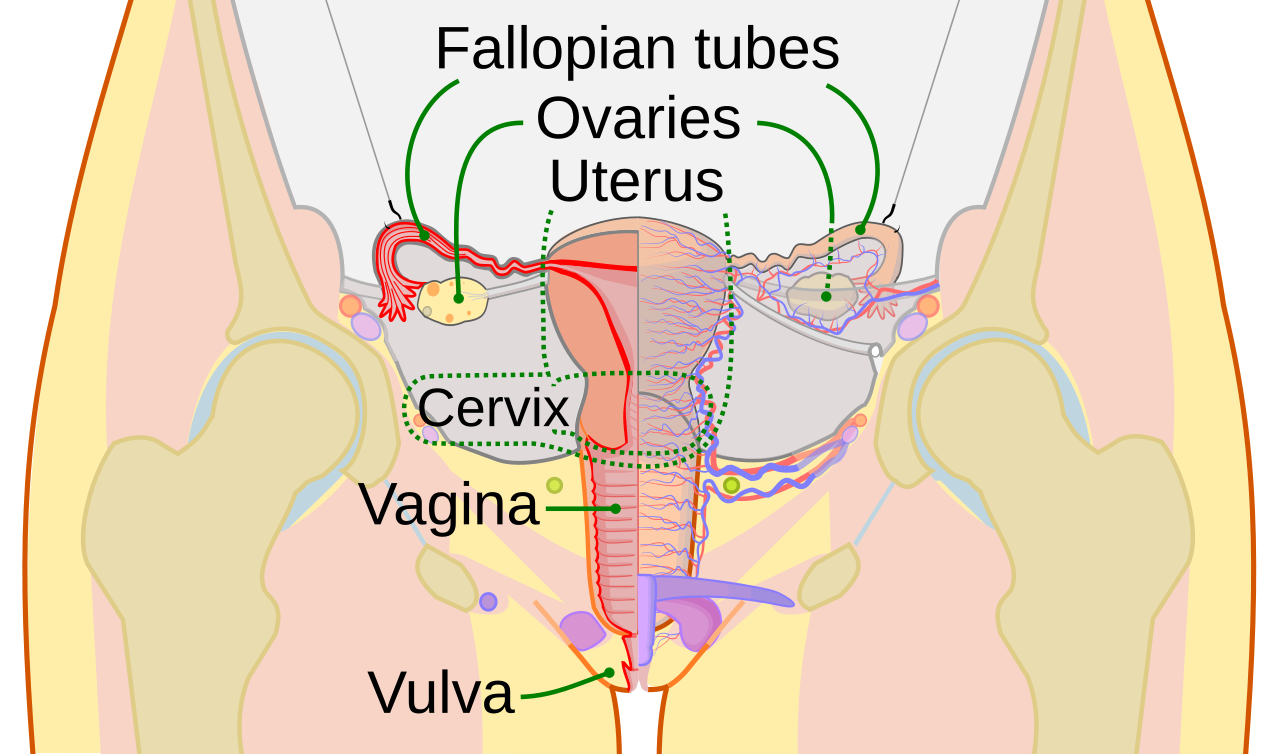
| Structure | Function |
|---|---|
| Ovaries | produce eggs (ova) and hormones (oestrogen, progesterone) |
| Fallopian tubes (oviducts) | carry egg from ovary to uterus; site of fertilisation |
| Uterus | muscular chamber; site of fetal development |
| Cervix | lower part of uterus; holds fetus in place; dilates during birth |
| Vagina | receives sperm during intercourse; birth canal |
The Menstrual Cycle
The menstrual cycle is approximately 28 days and prepares the uterus for a potential pregnancy each month.
| Days | Events | Hormones involved |
|---|---|---|
| 1–5 | menstruation: uterine lining shed | progesterone and oestrogen fall |
| 6–13 | uterine lining rebuilds; egg develops in follicle | FSH rises; oestrogen rises |
| ~14 | ovulation: egg released from ovary | LH surge triggers ovulation |
| 15–28 | uterine lining maintained; if no fertilisation, lining breaks down | progesterone (from corpus luteum) then falls |
- FSH (follicle-stimulating hormone) — from pituitary; stimulates follicle and egg development; triggers oestrogen production
- LH (luteinising hormone) — from pituitary; surge at day 14 triggers ovulation
- Oestrogen — from ovary; rebuilds uterine lining; triggers LH surge
- Progesterone — from corpus luteum (remains of follicle); maintains uterine lining
Menstrual Cycle Graphs
Past papers often test the menstrual cycle using hormone graphs. Use these patterns:
- Oestrogen rises before ovulation as the follicle develops and the uterine lining repairs.
- A high oestrogen level helps trigger the LH surge, which causes ovulation.
- Progesterone rises after ovulation because the corpus luteum forms and maintains the uterine lining.
- If there is no pregnancy, progesterone and oestrogen fall, and menstruation begins.
- If pregnancy occurs, progesterone and oestrogen remain high to maintain the uterine lining and prevent another ovulation.
If the corpus luteum fails to develop after fertilisation, progesterone may not remain high enough to maintain the uterine lining, so the pregnancy may fail. If the ovaries are removed before puberty, ova and ovarian hormones are not produced, so normal menstrual cycles and female secondary sexual development do not occur.
Fertilisation and Development
Sperm are deposited in the vagina and swim through the cervix and uterus into the fallopian tubes. If an egg is present, one sperm penetrates it — this is fertilisation. The fertilised egg (zygote) divides repeatedly and implants in the uterine wall about 7 days after fertilisation.
The placenta develops where the embryo attaches to the uterine wall. It allows exchange of substances between maternal and fetal blood without the blood mixing:
- oxygen and nutrients pass from mother to fetus
- CO₂ and urea pass from fetus to mother
- the placenta also produces hormones to maintain pregnancy
The umbilical cord connects the fetus to the placenta.
The amnion is a fluid-filled sac that surrounds and protects the developing fetus. Amniotic fluid cushions the fetus against physical shocks, prevents desiccation, and allows the fetus to move freely during development.
Contraception
| Method | Type | How it works |
|---|---|---|
| Condom | barrier | physical barrier; also protects against STIs |
| Diaphragm | barrier | covers cervix; prevents sperm reaching egg |
| Contraceptive pill | hormonal | contains oestrogen/progesterone; prevents ovulation |
| Contraceptive injection / implant | hormonal | releases progesterone; prevents ovulation |
| IUD (coil) | intrauterine device | prevents implantation; some release hormones |
| Vasectomy | surgical | cuts vas deferens; permanent |
| Tubal ligation | surgical | cuts or blocks fallopian tubes; permanent |
| Natural (rhythm method) | behavioural | avoiding intercourse near ovulation; least reliable |
Exam Tip
Contraception questions often ask for where the method acts. Condoms stop sperm entering the vagina and also reduce STI transmission. Pills, injections, and implants prevent ovulation. IUDs may prevent implantation. Vasectomy stops sperm travelling through the vas deferens; tubal ligation stops egg and sperm meeting in the oviduct.
Sexually Transmitted Infections
| Infection | Pathogen | Transmission | Treatment / Control |
|---|---|---|---|
| HIV/AIDS | virus (HIV) | unprotected sex, sharing needles, mother to child | no cure; antiretroviral drugs manage symptoms; condoms and not sharing needles prevent transmission |
| Gonorrhoea | bacterium (Neisseria gonorrhoeae) | unprotected sex | antibiotics; condoms; testing and contact tracing |
HIV attacks helper T-lymphocytes, gradually destroying the immune system. AIDS is the late stage when immunity has collapsed and opportunistic infections occur.
Exam Tip
HIV is transmitted through blood, semen, vaginal fluids, and breast milk — not through casual contact. An exam question may ask you to distinguish HIV (the virus) from AIDS (the condition that results from advanced HIV infection).