Heredity and Genetics
Matthew Williams
||8 min read|Continuity and VariationCSEC BiologyGeneticsInheritanceMendelian GeneticsSection CSex Linkage
Mendelian inheritance, dominance types, ABO blood groups, sex determination, sex-linked traits, and pedigree analysis.
Genetics is the study of how characteristics are transmitted from parent to offspring. Traits are controlled by genes — units of inheritance located at specific positions (loci) on chromosomes. Each gene may exist in alternative forms called alleles, and the combination an individual inherits determines their genetic makeup.
Core Terminology
These terms appear throughout genetics problems and must be defined precisely.
| Term | Definition |
|---|---|
| Gene | A unit of inheritance controlling a particular characteristic |
| Allele | An alternative form of a gene |
| Genotype | The genetic composition for a trait (e.g. Tt, TT, tt) |
| Phenotype | The observable expression of the genotype |
| Dominant allele | Expressed in the phenotype when one or two copies are present |
| Recessive allele | Expressed only when two copies are present (no dominant allele) |
| Homozygous | Two identical alleles (e.g. TT or tt) |
| Heterozygous | Two different alleles (e.g. Tt) |
Mendelian Inheritance
Gregor Mendel established the principles of inheritance through controlled crosses with pea plants. His key insight was that traits are governed by discrete factors — alleles — that separate during reproduction and recombine randomly.
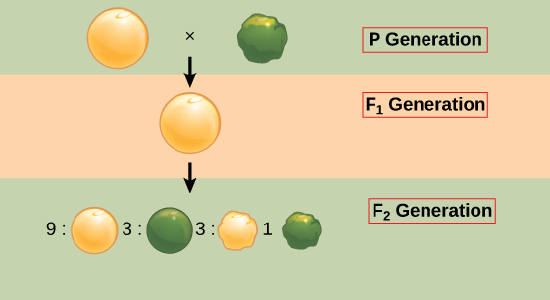
When a pure-breeding tall plant (TT) was crossed with a pure-breeding dwarf plant (tt), all F1 offspring were tall — the tallness allele is dominant. When F1 plants (Tt) were crossed with each other, the F2 generation showed a 3:1 ratio of tall to dwarf. This result is a cornerstone of monohybrid inheritance.
Law of Segregation: Allele pairs separate during gamete formation so each gamete carries only one allele. Alleles recombine randomly at fertilisation.
Punnett Squares
A Punnett square maps all possible allele combinations from a cross. Each parent's gametes line the top and side; the boxes show possible offspring genotypes.
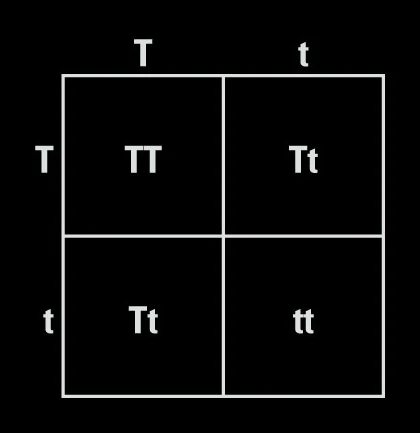
For Tt × Tt:
| T | t | |
|---|---|---|
| T | TT | Tt |
| t | Tt | tt |
- Genotype ratio: 1 TT : 2 Tt : 1 tt
- Phenotype ratio: 3 tall : 1 dwarf
These ratios express probability, not guaranteed outcomes. Small sample sizes and unequal survival can shift observed ratios away from the theoretical values.
Types of Dominance
Not all alleles follow simple dominant-recessive relationships.
| Type | Description | Example | F1 phenotype | F2 ratio |
|---|---|---|---|---|
| Complete dominance | One allele fully masks the other | Pea plant height | Dominant only | 3:1 |
| Incomplete dominance | Heterozygote is intermediate | Snapdragon colour | Blend (e.g. pink) | 1:2:1 |
| Codominance | Both alleles fully expressed together | ABO blood groups (IA IB) | Both traits visible | 1:2:1 |
Incomplete dominance — snapdragon: Red (RR) × White (rr) → all Pink (Rr) in F1. Crossing two pink plants: 1 Red : 2 Pink : 1 White.
Codominance — Shorthorn cattle: Red × White → Roan (cattle with both red and white hairs), because both alleles are expressed simultaneously.
Multiple Alleles: ABO Blood Groups
The ABO system is controlled by three alleles — IA, IB, and IO — where IA and IB are codominant and IO is recessive to both.
| Blood Group | Possible Genotypes | Antigens on RBC |
|---|---|---|
| A | IA IA or IA IO | A antigen |
| B | IB IB or IB IO | B antigen |
| AB | IA IB | A and B antigens |
| O | IO IO | None |
Blood group O is the universal donor (no antigens to trigger rejection); AB is the universal recipient (neither A nor B antibodies in plasma).
Test Cross
A test cross determines the genotype of an organism showing the dominant phenotype by crossing it with a homozygous recessive individual.
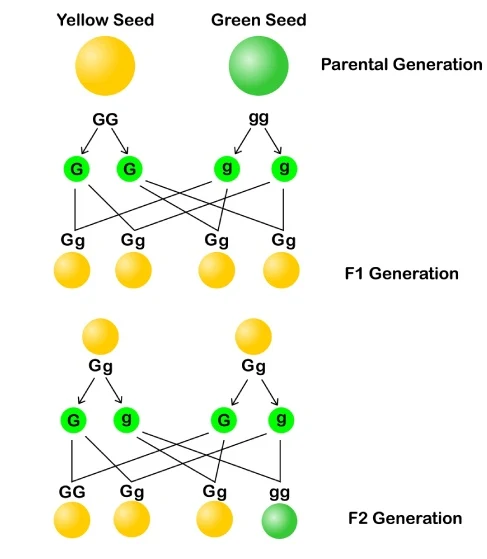
- All offspring show dominant phenotype → unknown parent is homozygous dominant (AA)
- 1:1 ratio of dominant to recessive offspring → unknown parent is heterozygous (Aa)
Sex Determination
In humans, sex is determined by the sex chromosomes. Females carry two X chromosomes (XX); males carry one X and one Y (XY). Eggs always carry X; sperm carry either X or Y — so it is the sperm that determines the sex of the offspring.
The probability of producing a male or female offspring is equal (approximately 1:1) in any given pregnancy.
Sex-Linked Inheritance
Genes located on the X chromosome are described as sex-linked. Because males have only one X chromosome, they express any allele on it — including recessive ones — without needing a second copy. This is why sex-linked recessive conditions are far more common in males.
| Genotype | Individual | Status |
|---|---|---|
| XH XH | Female | Unaffected |
| XH Xh | Female | Carrier (unaffected, but carries recessive allele) |
| Xh Xh | Female | Affected |
| XH Y | Male | Unaffected |
| Xh Y | Male | Affected |
Colour blindness (red-green) is the most common sex-linked recessive condition examined at CSEC. The normal vision allele (XH) is dominant over the colour-blind allele (Xh).
Example cross: carrier female × unaffected male (XH Xh × XH Y)
| XH | Y | |
|---|---|---|
| XH | XH XH (unaffected female) | XH Y (unaffected male) |
| Xh | XH Xh (carrier female) | Xh Y (colour-blind male) |
Result: daughters are unaffected (though one in two is a carrier); 50% of sons are colour-blind.
Haemophilia follows the same pattern — a sex-linked recessive condition in which blood fails to clot normally.
Exam Tip
Always write sex-linked genotypes with the X and Y chromosomes explicit — XH Xh, not just Hh. This makes clear to the examiner that you understand the gene is carried on the X chromosome. Showing the Punnett square with X and Y columns and rows earns full method marks even if one offspring genotype is wrong.
Pedigree Analysis
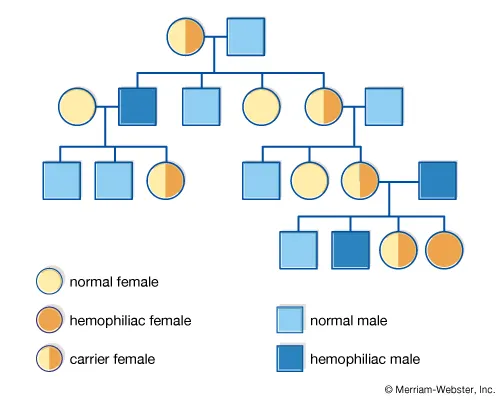
A pedigree chart traces the inheritance of a trait through multiple generations. Circles represent females; squares represent males; shaded symbols indicate affected individuals; horizontal lines connect parents; vertical lines lead to offspring.
| Observed pattern | Interpretation |
|---|---|
| Two unaffected parents → affected child | Trait is recessive (both parents are carriers) |
| Trait appears in every generation | Trait is likely dominant |
| Trait skips generations | Trait is recessive |
| Affected individuals mostly male | Possibly sex-linked recessive |
| Father-to-son transmission | Cannot be X-linked (fathers pass Y to sons) |
When interpreting pedigrees, start by determining whether the trait is dominant or recessive, then decide whether it is autosomal or sex-linked.
Summary of Key Principles
- Traits are controlled by alleles on chromosomes; dominant alleles are expressed over recessive ones
- Mendelian ratios (3:1, 1:2:1, 1:1) describe probability of offspring phenotypes, not guaranteed outcomes
- Incomplete dominance and codominance modify the standard 3:1 ratio to 1:2:1
- Sex is determined by sex chromosomes; sex-linked genes are on the X chromosome and show different patterns in males and females
- Pedigree charts allow inference of genotype and inheritance pattern across generations