Excretion and Homeostasis
Matthew Williams
||9 min read|CSEC BiologyExcretionHomeostasisKidneysSection BTemperature Regulation
Excretion vs egestion, bilirubin, plant excretion, kidney structure, nephron function, dialysis, osmoregulation, ADH, skin structure, melanin, SPF, and temperature regulation.
The body constantly produces waste products from its chemical reactions. Excretion removes these before they accumulate to toxic levels. At the same time, the body maintains a stable internal environment — a process called homeostasis.
Excretion vs Egestion
These two terms are often confused:
| Term | Meaning | Example |
|---|---|---|
| Excretion | removal of metabolic waste products produced inside the body | urea in urine, CO₂ in exhaled air |
| Egestion | removal of undigested food that was never absorbed | faeces |
Faeces is not simply an excretory product — it largely consists of undigested material. However, it does contain bilirubin, which is a genuine excretory product: it is formed in the liver from the breakdown of haemoglobin in old red blood cells and is excreted via bile into the gut, giving faeces their brown colour.
Metabolic Wastes and Where They Leave
| Waste product | Produced by | Organ of excretion |
|---|---|---|
| Carbon dioxide | aerobic respiration in all cells | lungs (exhaled) |
| Water | aerobic respiration; various metabolic reactions | kidneys (urine), lungs, skin |
| Urea | deamination of excess amino acids in the liver | kidneys (urine) |
Urea formation: When the body has more amino acids than it needs, the liver removes the nitrogen-containing amino group (deamination), converts it to ammonia, then combines it with CO₂ to form urea. Urea passes into the blood and is filtered by the kidneys.
Excretion in Plants
Plants also produce metabolic wastes and have their own methods of dealing with them:
| Method | How it works |
|---|---|
| Leaf fall | waste products (e.g. calcium oxalate, tannins) accumulate in leaves; entire leaves shed seasonally |
| Loss of bark | some waste compounds stored in bark, which peels away over time |
| Storage | some wastes (e.g. resins, tannins) are locked in non-living heartwood or vacuoles where they cannot harm the plant |
Plants also release CO₂ (from respiration) and O₂ (from photosynthesis) through stomata — gases are exchanged, not strictly stored as waste.
The Urinary System and Kidney Structure
The kidneys filter blood, regulate water balance, and excrete urea in urine.
Urine passes from kidneys → ureters → bladder → urethra (out of the body).
Each kidney has:
- cortex — outer region; contains glomeruli and Bowman's capsules
- medulla — inner region; contains loops of Henle and collecting ducts
- pelvis — central space where urine collects before draining into the ureter
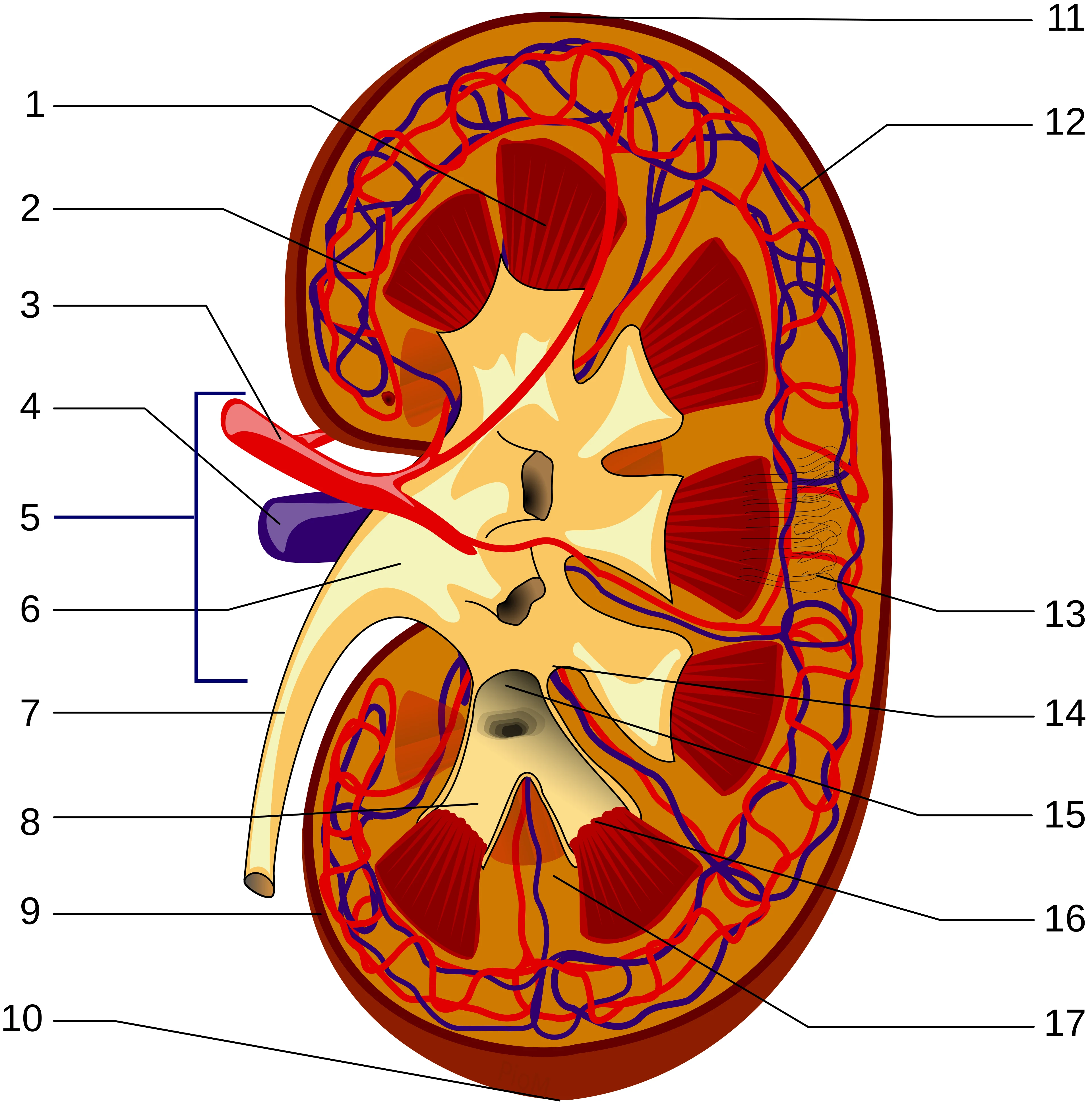
Key1.Renal pyramid2.Interlobular artery3.Renal artery4.Renal vein5.Renal hilum6.Renal pelvis7.Ureter8.Minor calyx9.Fibrous capsule (inferior)10.Fibrous capsule (superior)11.Interlobular vein12.Nephron13.Minor calyx14.Major calyx15.Renal papilla16.Renal column
The Nephron
The nephron is the functional unit of the kidney. Each kidney contains about one million nephrons. The nephron filters blood and selectively recovers useful substances.
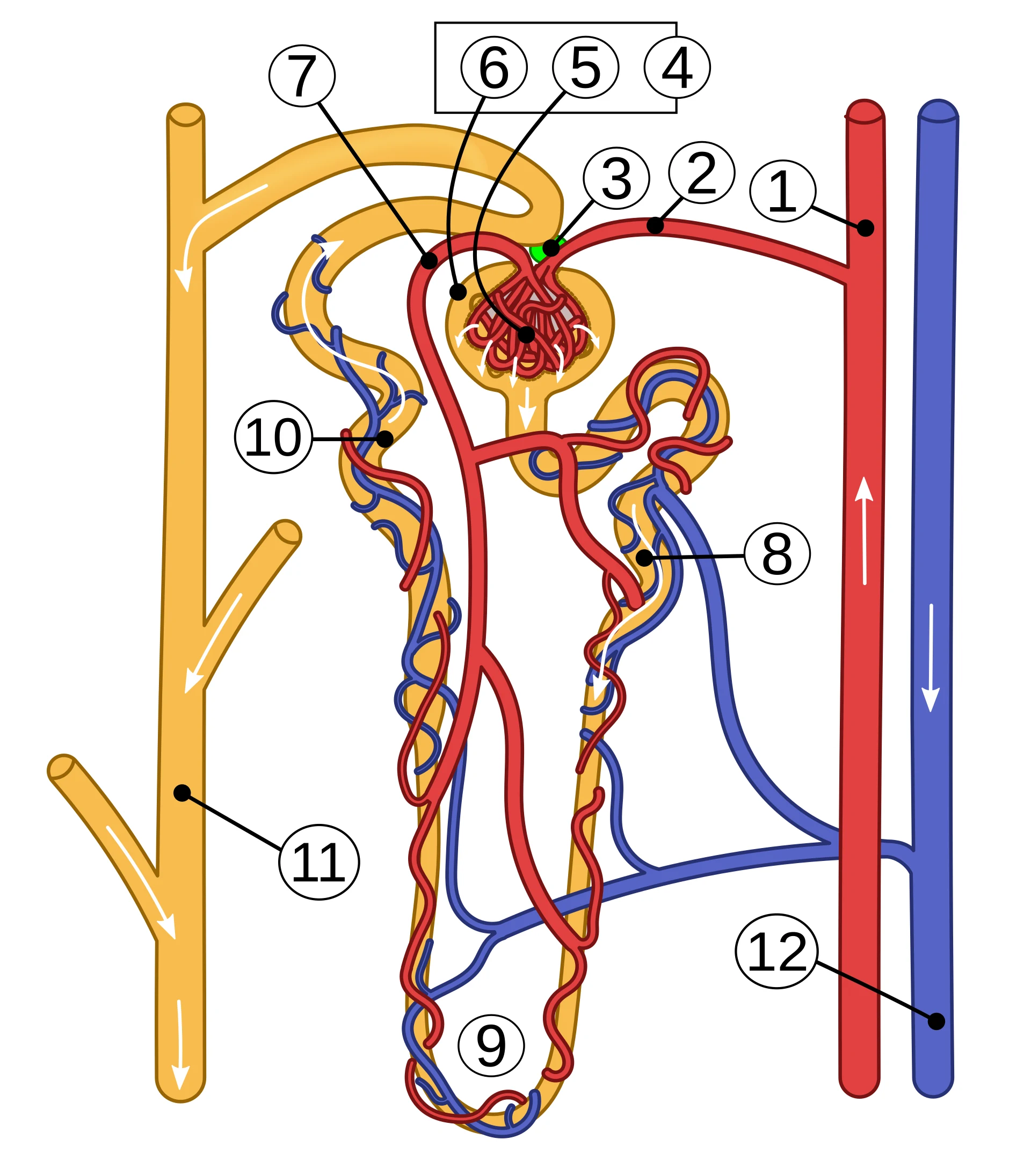
Key1.Interlobular artery2.Afferent arteriole3.Juxtaglomerular apparatus4.Renal corpuscle5.Glomerulus6.Bowman's capsule7.Efferent arteriole8.Proximal convoluted tubule9.Loop of Henle10.Distal convoluted tubule11.Connecting tubule12.Interlobular vein
Ultrafiltration
Blood enters the glomerulus (a tight knot of capillaries inside the Bowman's capsule) under high pressure. Small molecules are forced out of the blood into the Bowman's capsule. Large molecules (proteins, red blood cells) are too big to pass through and stay in the blood.
What is filtered into the capsule: water, glucose, urea, mineral ions, amino acids.
Selective Reabsorption
As the filtrate travels along the nephron, useful substances are recovered back into the blood:
| Substance | Reabsorbed? | How |
|---|---|---|
| Glucose | completely (if blood glucose is normal) | active transport in proximal tubule |
| Amino acids | yes | active transport in proximal tubule |
| Water | most of it | osmosis throughout; amount adjusted by ADH |
| Urea | small amount | mostly remains in urine |
| Mineral ions | adjusted according to body's needs | active transport |
The remaining fluid is urine — mostly water, urea, and mineral salts.
Osmoregulation and ADH
Osmoregulation is the control of the water concentration of body fluids. This is critical because cells shrink or swell if the surrounding fluid concentration changes.
The hypothalamus monitors blood water concentration and controls the release of ADH (antidiuretic hormone) from the pituitary gland.
| Blood water concentration | ADH released | Effect on kidney | Urine produced |
|---|---|---|---|
| Too low (blood too concentrated) | more ADH | collecting duct becomes more permeable to water; more water reabsorbed | small volume, concentrated urine |
| Too high (blood too dilute) | less ADH | collecting duct less permeable; less water reabsorbed | large volume, dilute urine |
This is a negative feedback mechanism — the response opposes the change, returning the system toward normal.
Exam Tip
On a hot day with heavy sweating, you lose water through your skin. Blood becomes more concentrated → more ADH released → kidneys retain more water → small volume of concentrated (dark) urine is produced. Drinking more water reverses this.
Kidney Failure and Dialysis
If the kidneys fail, urea and other wastes accumulate in the blood to toxic levels. Treatment options:
- Dialysis (haemodialysis) — blood is passed through a machine containing a selectively permeable membrane bathed in dialysis fluid. Urea and excess ions diffuse out of the blood across the membrane; glucose, useful salts, and blood cells are retained. The patient typically needs dialysis several times per week.
- Kidney transplant — a healthier long-term solution; donor organ must be well-matched to avoid rejection.
The Skin
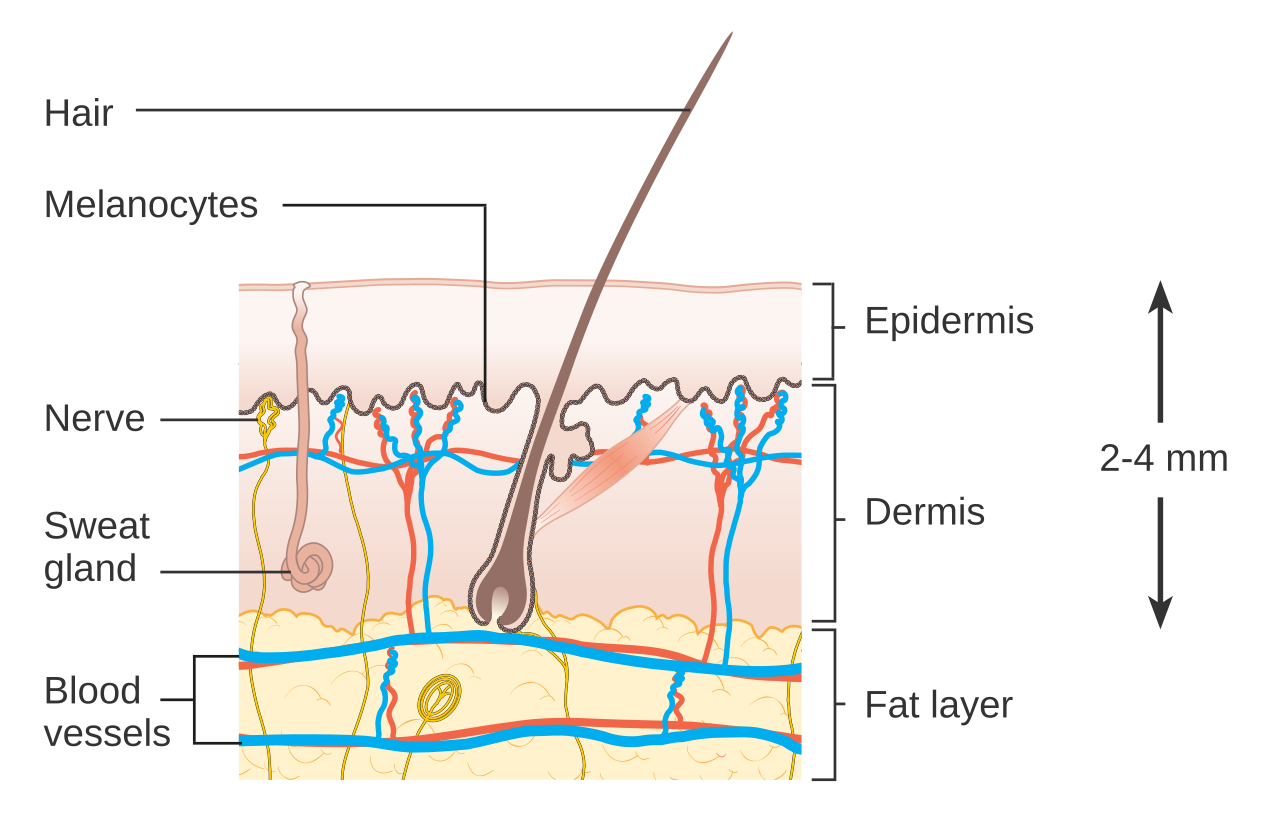
The skin has two main layers:
- Epidermis — outer layer; tough, protective; contains melanocytes that produce melanin (pigment responsible for skin, hair, and eye colour)
- Dermis — deeper layer; contains blood capillaries, sweat glands, hair follicles, sense receptors, and fat cells
Functions of the skin
- protection against pathogens, dehydration, UV radiation, and physical damage
- temperature regulation
- sensation (touch, pressure, pain, temperature)
- vitamin D synthesis (using sunlight)
- minor excretion of salts and urea in sweat
Melanin and UV Protection
Melanin absorbs UV radiation from sunlight, protecting the DNA in skin cells from damage that can lead to skin cancer. The more melanin in the skin, the darker the complexion. Production increases with UV exposure (tanning).
SPF (Sun Protection Factor) is a measure of how well a sunscreen blocks UV radiation. An SPF of 30 blocks about 97% of UVB rays. SPF is relevant because UV radiation can cause sunburn, premature skin ageing, and skin cancer — particularly in individuals with lower melanin levels.
Skin bleaching refers to the use of chemical agents (e.g. hydroquinone, mercury compounds) to reduce melanin production, lightening skin tone. While widely practised in some Caribbean communities, skin bleaching carries significant health risks: mercury is toxic to the kidneys and nervous system, and reduced melanin leaves the skin more vulnerable to UV damage and skin cancer.
Temperature Regulation
The body maintains core temperature at about 37°C — the optimum for enzyme activity. The hypothalamus acts as the thermostat, detecting temperature changes in the blood and sending signals to effectors in the skin.
| Response | When | Mechanism |
|---|---|---|
| Vasodilation | too hot | blood capillaries near skin surface widen; more blood flows through; heat lost by radiation |
| Vasoconstriction | too cold | capillaries narrow; less blood near surface; heat retained |
| Sweating | too hot | sweat glands secrete water and salts onto skin; evaporation carries away heat |
| Shivering | too cold | rapid involuntary muscle contractions; friction generates heat |
| Piloerection | too cold | hair erector muscles raise hairs; traps layer of air as insulation (more effective in furry animals than in humans) |
Remember
Vasodilation and vasoconstriction change how much blood flows near the skin surface, not whether blood flows to the skin. The capillaries open or narrow; the blood volume in the body does not change.