Coordination and Response
Matthew Williams
||14 min read|CSEC BiologyHormonesNervous SystemReflexSection BTropisms
Stimulus and response, the nervous system, reflex arcs, brain regions, the eye, glaucoma, invertebrate responses, endocrine hormones, plant tropisms, and drug abuse.
Living organisms need to detect and respond to changes in their environment to survive. Rapid changes are handled by the nervous system; slower, longer-lasting changes are managed by hormones. Both systems work by linking a stimulus (a change) to a response (an action).
Stimulus and Response
A stimulus is any change in the environment, internal or external, that can be detected by an organism. A response is the reaction to that stimulus. The pathway from stimulus to response follows a consistent pattern:
stimulus → receptor → coordinator → effector → response
- Receptor — detects the stimulus (e.g. light receptor in the eye, temperature receptor in skin)
- Coordinator — processes the signal and decides on a response (brain or spinal cord)
- Effector — carries out the response (muscle or gland)
Responding to stimuli is important for survival: finding food, avoiding predators, maintaining body temperature, and escaping harmful conditions.
The Nervous System
The nervous system is divided into:
- Central nervous system (CNS) — brain and spinal cord; processes information and coordinates responses
- Peripheral nervous system (PNS) — all nerves that connect the CNS to the rest of the body
Neurones
Neurones are specialised cells that carry electrical impulses. There are three types:
| Type | Function | Location |
|---|---|---|
| Sensory | carries impulses from receptor to CNS | sense organs to brain/spinal cord |
| Relay (interneurone) | connects sensory and motor neurones within the CNS | brain and spinal cord |
| Motor | carries impulses from CNS to effector | brain/spinal cord to muscles or glands |
A typical neurone has:
- dendrites — short extensions that receive impulses from other neurones
- cell body — contains nucleus and cytoplasm
- axon — long fibre that carries the impulse away from the cell body
- myelin sheath — fatty insulation that speeds up impulse transmission
- synaptic knob — tip of the axon where neurotransmitters are released
Synapses
A synapse is the gap between two neurones. Electrical impulses cannot jump the gap directly. Instead:
- Impulse arrives at synaptic knob
- Neurotransmitter molecules are released into the gap
- Neurotransmitter diffuses across and binds to receptors on the next neurone
- A new impulse is generated in the next neurone
Synapses ensure impulses travel in one direction only.
Reflex Actions
A reflex is a rapid, automatic, involuntary response to a stimulus. Reflexes are important because they protect the body before the brain has time to process the situation consciously.
Reflex arc: receptor → sensory neurone → relay neurone (in spinal cord) → motor neurone → effector
Example: touching something hot → hand pulls away before conscious thought. The signal detours through the spinal cord without waiting for the brain, then the brain receives the signal afterwards.
InfoHelpful but not required: spinal cord and spinal nerves
The syllabus explicitly says that diagrams showing the spinal cord and spinal nerves are not required. Still, it may help to know the idea: nerves connected directly to the brain are called cranial nerves, while nerves connected to the spinal cord are called spinal nerves. A withdrawal reflex, such as pulling your hand away from heat, is usually a spinal reflex because the impulse is coordinated through the spinal cord before the brain becomes consciously aware.
The Brain
The brain is the main coordinator of the nervous system. Three key regions to know:
| Region | Main functions |
|---|---|
| Cerebrum | conscious thought, memory, learning, language, voluntary movement, interpreting sensory information |
| Cerebellum | coordination of movement, balance, posture, fine motor control |
| Medulla oblongata | automatic (involuntary) functions: heart rate, breathing rate, peristalsis, swallowing |
The Eye
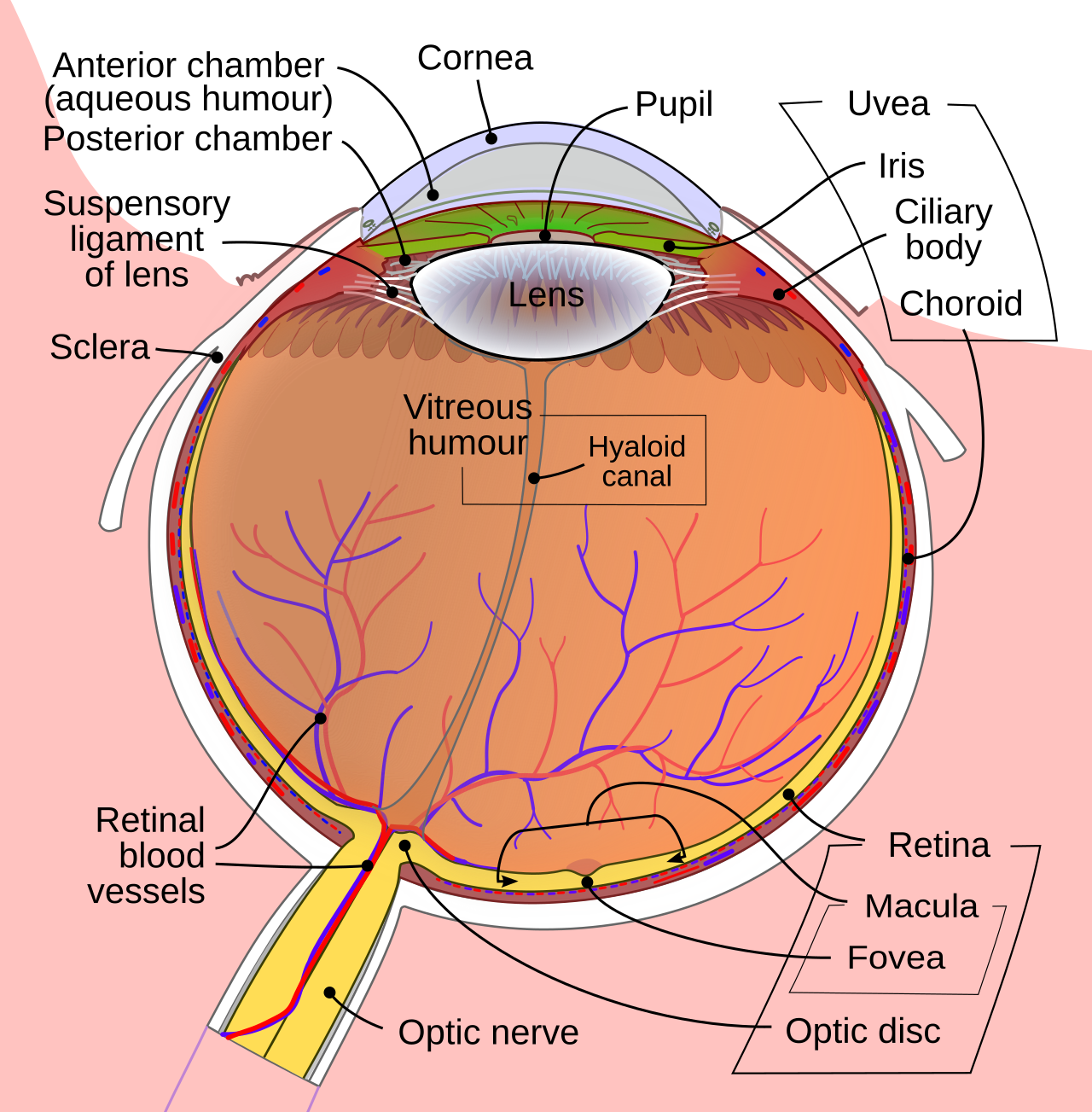
The eye is the sense organ for light. Each part has a specific function:
| Structure | Function |
|---|---|
| Cornea | transparent covering; refracts (bends) most of the incoming light |
| Choroid | black, blood-rich layer; supplies the eye with oxygen and nutrients and absorbs stray light to prevent internal reflection |
| Iris | controls pupil size; adjusts amount of light entering |
| Pupil | opening in the iris through which light passes |
| Lens | adjusts focus by changing shape (accommodation) |
| Retina | contains light-sensitive cells (rods and cones) |
| Rods | detect light and dark; work in dim light; no colour |
| Cones | detect colour; require bright light; concentrated at fovea |
| Optic nerve | carries impulses from retina to brain |
Accommodation
Accommodation is the process of changing the shape of the lens to focus on objects at different distances.
| Viewing | Ciliary muscles | Suspensory ligaments | Lens shape | Focal length |
|---|---|---|---|---|
| Near object | contract | relax (slack) | fat (more curved) | short |
| Distant object | relax | taut (pull lens) | thin (less curved) | long |
Eye Defects
| Defect | Cause | Correction |
|---|---|---|
| Myopia (short-sightedness) | eyeball too long; image forms in front of retina | concave (diverging) lens |
| Hyperopia (long-sightedness) | eyeball too short; image would form behind retina | convex (converging) lens |
| Glaucoma | fluid pressure builds up inside the eye, damaging the optic nerve | eye drops, laser treatment, or surgery to reduce pressure |
Exam Tip
Glaucoma is caused by increased fluid pressure inside the eye — it damages the optic nerve and can cause blindness if untreated. It is different from myopia/hyperopia, which involve the shape of the eyeball.
Skin as a Sense Organ
The skin contains several types of receptor that respond to different stimuli:
- touch and pressure receptors — detect contact and weight
- temperature receptors — separate receptors for heat and cold
- pain receptors — respond to damaging stimuli; trigger protective reflexes
Hormones and the Endocrine System
Hormones are chemical messengers produced by endocrine glands, released into the blood, and carried to target organs. Their effects are slower but longer-lasting than nerve impulses.
| Gland | Hormone(s) | Target | Effect |
|---|---|---|---|
| Pancreas (islets of Langerhans) | insulin | liver, muscle, fat cells | lowers blood glucose: promotes glucose uptake and glycogen storage |
| Pancreas | glucagon | liver | raises blood glucose: breaks down glycogen to glucose |
| Adrenal glands | adrenaline | heart, muscles, liver | prepares body for "fight or flight": raises heart rate, dilates pupils, releases glucose |
| Pituitary gland | ADH | kidney collecting duct | increases water reabsorption |
| Pituitary gland | FSH, LH | ovaries | control menstrual cycle and ovulation |
| Ovaries | oestrogen, progesterone | uterus and elsewhere | control female reproductive cycle |
| Testes | testosterone | body | male secondary sexual characteristics; sperm production |
| Thyroid | thyroxine | whole body | regulates metabolic rate |
Nervous vs Hormonal Control
| Feature | Nervous | Hormonal |
|---|---|---|
| Speed | very fast (milliseconds) | slow (seconds to minutes) |
| Duration | short-lived | longer-lasting |
| Transmission | electrical impulse along neurones | chemicals in blood |
| Specificity | precise: specific target | widespread: reaches all cells but only target cells respond |
| Example | reflex action | insulin controlling blood sugar |
Responses of Invertebrates
Invertebrates such as woodlice, earthworms, and millipedes show clear behavioural responses to environmental stimuli. These responses improve survival:
| Stimulus | Typical response | Survival advantage |
|---|---|---|
| Light intensity | move away from bright light (negative phototaxis) | avoid desiccation and predators; remain under leaf litter |
| Temperature | move toward moderate warmth; avoid extremes | prevent overheating or freezing |
| Moisture | move toward humid areas (positive hydrotropism) | prevent desiccation; maintain cell function |
These responses can be investigated in a choice chamber — a container divided into two regions with different conditions. The number of animals in each region after a set time indicates their preference.
Exam Tip
Invertebrate-response questions may use unfamiliar examples. For example, Daphnia move upward in darkness to feed on algae. Artificial light at night can disrupt this behaviour, so fewer may come to the surface, feeding patterns may change, and the food web may be affected. Apply the same rule: identify the stimulus, describe the response, then link it to survival or feeding.
Plant Tropisms
Plants respond to environmental stimuli by growing toward or away from them. These growth movements are called tropisms.
| Tropism | Stimulus | Response |
|---|---|---|
| Phototropism | light | shoot grows toward light (positive); root grows away (negative) |
| Geotropism | gravity | root grows downward (positive); shoot grows upward (negative) |
| Thigmotropism | touch/contact | some climbing shoots or tendrils grow around a support |
Tropisms result from unequal growth — one side of the shoot or root elongates faster than the other, causing a bend. For the syllabus, focus on the stimulus, direction of growth, and survival advantage.
InfoHelpful but not required: auxins
The CSEC Biology syllabus explicitly mentions that the role of auxins is not required. The underlying idea may still be useful: auxins are plant hormones involved in growth. In shoots exposed to light from one side, auxins collect more on the shaded side. Cells on that shaded side elongate faster, so the shoot bends toward the light. This helps explain phototropism, but for the exam you mainly need the stimulus, direction of growth, and survival advantage.
Drug Abuse
Drugs are substances that alter the way the body or mind functions. They include legal drugs (alcohol, caffeine, prescription medicines) and illegal drugs (heroin, cocaine). Misuse of any drug — including the misuse of prescription drugs such as diet pills, tranquilisers, steroids, and analgesics — has physiological, social, and economic consequences.
Drug abuse means using a drug improperly, for example taking an illegal drug, taking medicine without medical need, taking the wrong dose, or using a drug repeatedly in a way that harms the body or mind.
Why Young People May Abuse Drugs
Young people may abuse drugs for several reasons:
| Reason | How it may lead to drug abuse |
|---|---|
| Curiosity or experimentation | trying a drug once can lead to repeated use, especially if the drug is addictive |
| Peer pressure | friends or social groups may make drug use seem normal or desirable |
| Stress, anxiety, or family problems | drugs may be used as an unhealthy way to cope with emotional pressure |
| Low self-esteem or body-image pressure | diet pills or stimulants may be misused by someone trying to lose weight quickly |
| Media and social media influence | unrealistic images of beauty, status, or lifestyle can encourage risky choices |
| Easy access to drugs | alcohol, cigarettes, prescription medicines, or illegal drugs may be available at home, in the community, or from peers |
| Addiction or dependence | after repeated use, the person may crave the drug and find it difficult to stop |
The textbook emphasises that addiction makes a person want more of the drug despite harm, and that giving up alcohol or other addictive drugs is difficult because withdrawal symptoms may occur. It also treats smoking among teenagers as an early warning sign for later substance abuse.
Measures to Reduce Drug Abuse
Drug abuse can be reduced by combining prevention, support, and control:
| Measure | How it helps |
|---|---|
| Education programmes in schools and communities | teach the short-term and long-term effects of drugs before habits form |
| Public awareness campaigns | correct misleading information, such as unsafe weight-loss claims about diet pills |
| Strong family and peer support | gives young people healthier ways to handle stress and resist peer pressure |
| Counselling and rehabilitation | help addicted persons understand triggers, change behaviour, and recover |
| Medical help during withdrawal | reduces danger when a person stops using an addictive substance |
| Enforcing laws on illegal drugs, alcohol, tobacco, and prescriptions | limits access and discourages selling or supplying harmful drugs |
| Healthy activities and support groups | provide belonging, confidence, and alternatives to drug-taking groups |
Alcohol
Alcohol (ethanol) is a legal depressant — it slows the nervous system:
- Short term: slowed reactions, impaired judgement, loss of coordination, lowered inhibitions
- Long term: liver cirrhosis (scarring that prevents normal liver function), brain damage, addiction, heart disease
Heroin (an illegal depressant)
Heroin is a highly addictive opiate that mimics natural pain-relief chemicals in the brain:
- Physiological: severe dependence; withdrawal is painful; sharing needles spreads HIV and hepatitis
- Social: crime to fund habit; breakdown of family relationships
- Economic: costly treatment; lost productivity; law enforcement burden
General Effects of Drug Abuse
| Effect type | Examples |
|---|---|
| Physiological | addiction and dependence; organ damage (liver from alcohol, lungs from tobacco); brain chemistry changes; withdrawal symptoms |
| Social | strained family relationships; crime; poor decision-making; loss of employment; neglect of responsibilities |
| Economic | cost of healthcare; reduced productivity; law enforcement costs; burden on families |
Exam Tip
Exam questions on drug abuse often ask for effects under multiple headings. Make sure you can give distinct answers for physiological, social, and economic effects — the same point will not score in two categories. If a question asks for ways to reduce drug abuse, give practical measures such as education, counselling, rehabilitation, family support, medical help, and law enforcement.